Webhooks vs. WebSockets for Indian Algo Trading: Optimizing Execution Latency in 2026 Webhooks vs. WebSockets for Indian Algo Trading: Optimizing Execution Latency in 2026 Author: WelthWest Quant Research Team…
Webhooks vs. WebSockets for Indian Algo Trading: Optimizing Execution Latency in 2026
In algorithmic trading, having a highly accurate AI screener is only half the battle. The other half is execution. If your system identifies a breakout on the National Stock Exchange (NSE) but takes 800 milliseconds to route the order to your broker, you have already lost your alpha to high-frequency trading (HFT) firms.
For independent developers and boutique quantitative firms building pipelines via platforms like n8n or custom Python scripts, the most critical architectural decision you will make is how data travels between your strategy engine and your broker. In 2026, this debate fundamentally comes down to two protocols: Webhooks vs. WebSockets.
This guide dissects the mechanics of both protocols, explains why slippage occurs, and provides a blueprint for optimizing order routing latency in the Indian equity and derivatives markets.
The Anatomy of Latency in Order Routing
Before comparing the protocols, we must understand the "Execution Gap." This is the time delta between your AI model generating a "Buy" signal and the exchange acknowledging your filled order.
Latency occurs at three primary hops:
- Data Ingestion: How fast your system receives the tick data from the exchange.
- Processing (The AI Layer): How fast your model (e.g., an OpenClaw instance or a custom Python script) computes the signal.
- Order Routing (The Protocol Layer): How fast the signal travels from your server to the broker API (e.g., Dhan API) and finally to the exchange matching engine.
Webhooks: The Event-Driven Workhorse
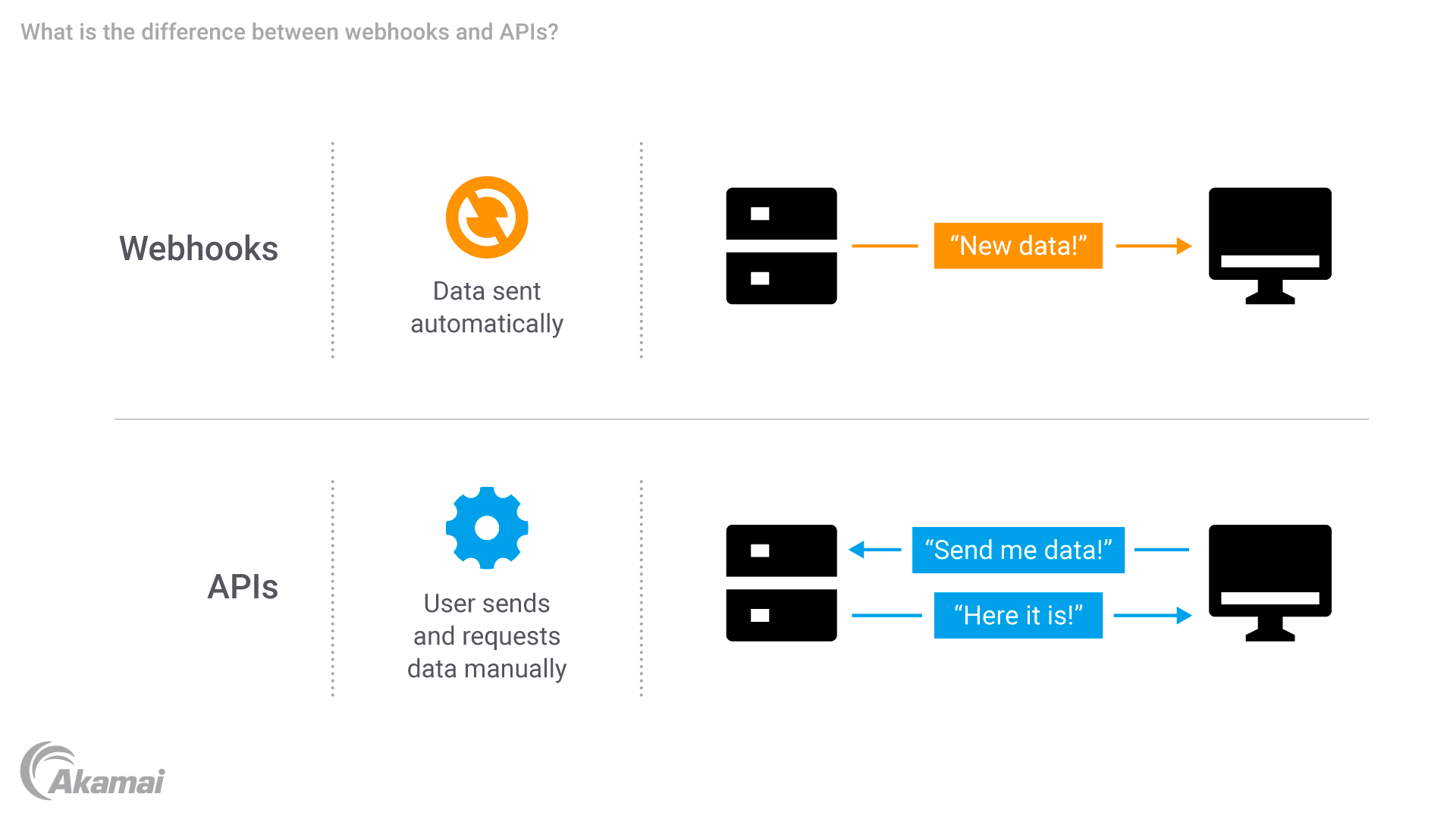
A Webhook is essentially a reverse HTTP API. Instead of your server constantly asking the broker, "Has the price changed?" (Polling), the broker sends an HTTP POST request to your designated URL only when a specific event occurs.
How it works in Trading:
You set an alert on TradingView or a custom AI screener. When the RSI crosses 70, TradingView fires a JSON payload to a Webhook URL hosted on your n8n server. The n8n node catches the payload, formats it, and fires a standard API request to your broker to execute the trade.
Pros of Webhooks:
- Incredibly Easy to Set Up: Platforms like Tradetron, TradingView, and n8n treat Webhooks as first-class citizens. You can configure a webhook in minutes without writing complex connection-handling code.
- Stateless and Resilient: If your server briefly goes down, many webhook providers will retry sending the payload.
- Low Server Overhead: Your server is idle until an event occurs, saving compute resources.
Cons of Webhooks (The Latency Trap):
- The HTTP Handshake Tax: Every time a webhook fires, it must establish a new TCP connection, complete a TLS handshake, send the data, and close the connection. This overhead can add 100ms to 300ms of latency per hop.
- One-Way Street: Webhooks are unidirectional. They tell you an event happened, but if you need to query follow-up data (like asking the broker for your current margin before placing the trade), you must initiate a completely separate, slow API call.
WebSockets: The Low-Latency Standard
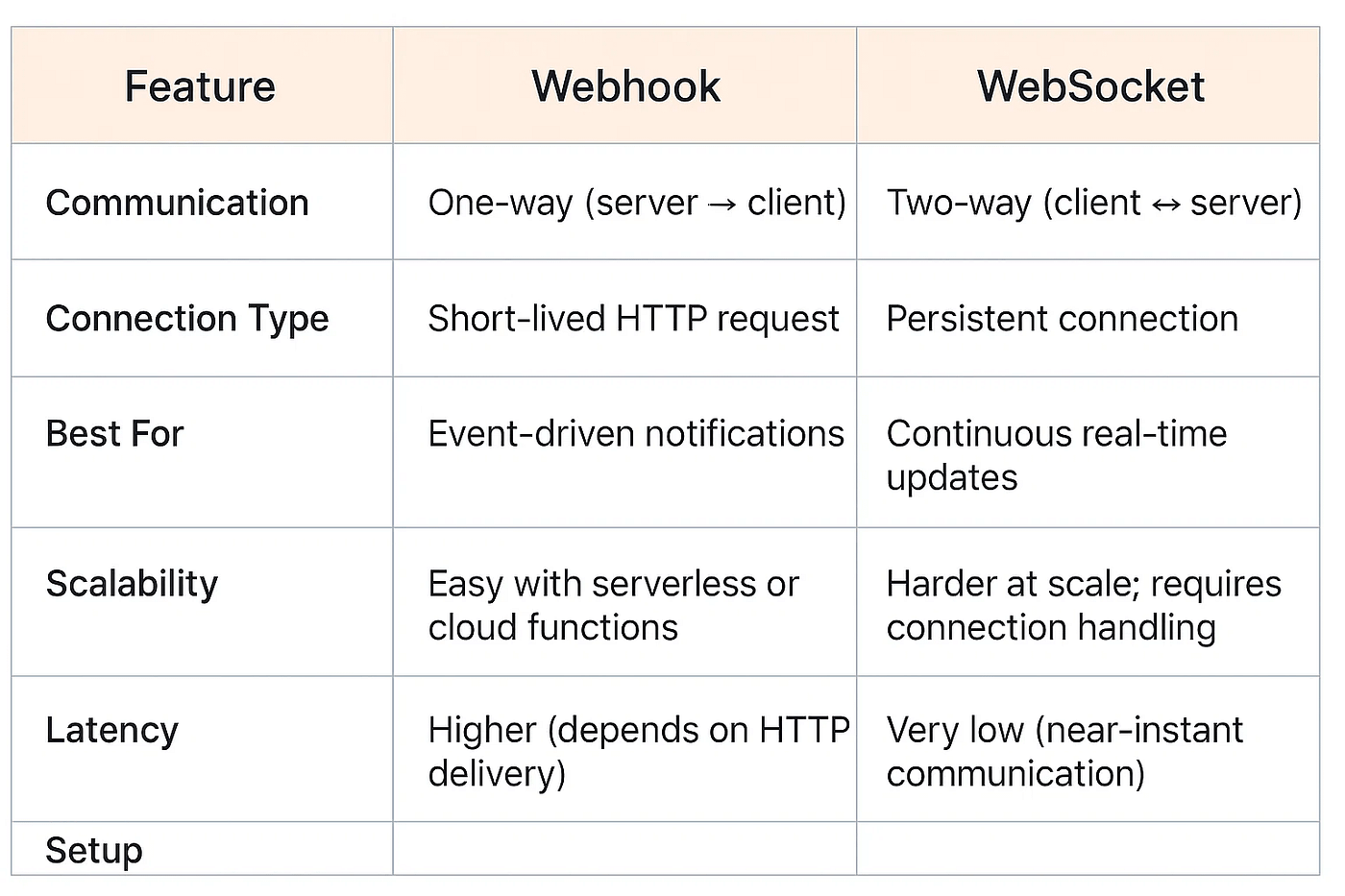
If Webhooks are like sending a certified letter, a WebSocket is like keeping an open phone line. A WebSocket establishes a persistent, bi-directional, full-duplex connection over a single TCP connection.
How it works in Trading:
Your Python script opens a WebSocket connection to the Dhan API at 9:15 AM. The connection stays open all day. The broker streams live tick data continuously. When your algorithm decides to buy, it sends the order payload back through that exact same open connection instantly.
Pros of WebSockets:
- Near-Zero Routing Latency: Because the connection is already established, data is transmitted with only the overhead of the network path itself. You eliminate the TLS handshake tax entirely.
- Real-Time Streaming: Essential for tick-by-tick data ingestion (Hop 1). You cannot build a realistic order book visualization using Webhooks.
- Bi-Directional: You can receive tick data and send order executions through the same pipe simultaneously.
Cons of WebSockets:
- Complex State Management: You must write code to handle disconnections, ping/pong heartbeats to keep the connection alive, and reconnect logic if the broker's server drops you.
- Resource Intensive: Maintaining thousands of open WebSocket connections requires significant memory and careful server architecture.
Which Protocol Should You Use?
The choice between Webhooks and WebSockets is not binary; it depends entirely on your trading frequency and strategy type.
| Strategy Type | Ideal Protocol | Why? |
|---|---|---|
| Swing Trading / End of Day (EOD) | Webhooks | Latency is irrelevant. A 2-second delay on a daily chart breakout will not impact your fill price. Webhooks offer easiest integration with tools like n8n. |
| Options Selling / Iron Condors | Webhooks (Usually) | If you are executing based on time decay (Theta) rather than rapid price momentum (Delta/Gamma), the simplicity of Webhooks outweighs the need for millisecond speed. |
| Scalping / Momentum Breakouts | WebSockets | A 300ms delay on a highly liquid stock like Reliance breaking a 1-minute resistance level will result in severe slippage. WebSockets are mandatory. |
| Market Making / Statistical Arbitrage | WebSockets + Co-Location | Requires continuous order book analysis and instant execution. Anything other than WebSockets is unviable. |
Optimizing Your Pipeline in 2026
If you are serious about algorithmic trading, you should ideally utilize a hybrid approach:
Use WebSockets for your data ingestion layer. Stream tick data directly into your custom script or a high-performance database. When your logic fires, if you are using an automation platform like n8n to orchestrate complex logic (e.g., checking margin across three different broker APIs before executing), ensure your servers are geographically close to the exchange to minimize the Webhook HTTP overhead.
Ready to Stop Guessing and Start Testing?
Execution latency means nothing if your underlying strategy is curve-fitted. Validate your quantitative logic against years of Indian market data before risking live capital.
Try WelthWest Backtesting (Beta)