Key Takeaway
The emerging 'Bart Simpson' pattern in Bitcoin and XRP signals potential crypto volatility, but its direct and immediate impact on Indian equities remains low. Investors should monitor global risk sentiment, with select IT and payment processing stocks facing indirect, long-term scrutiny.
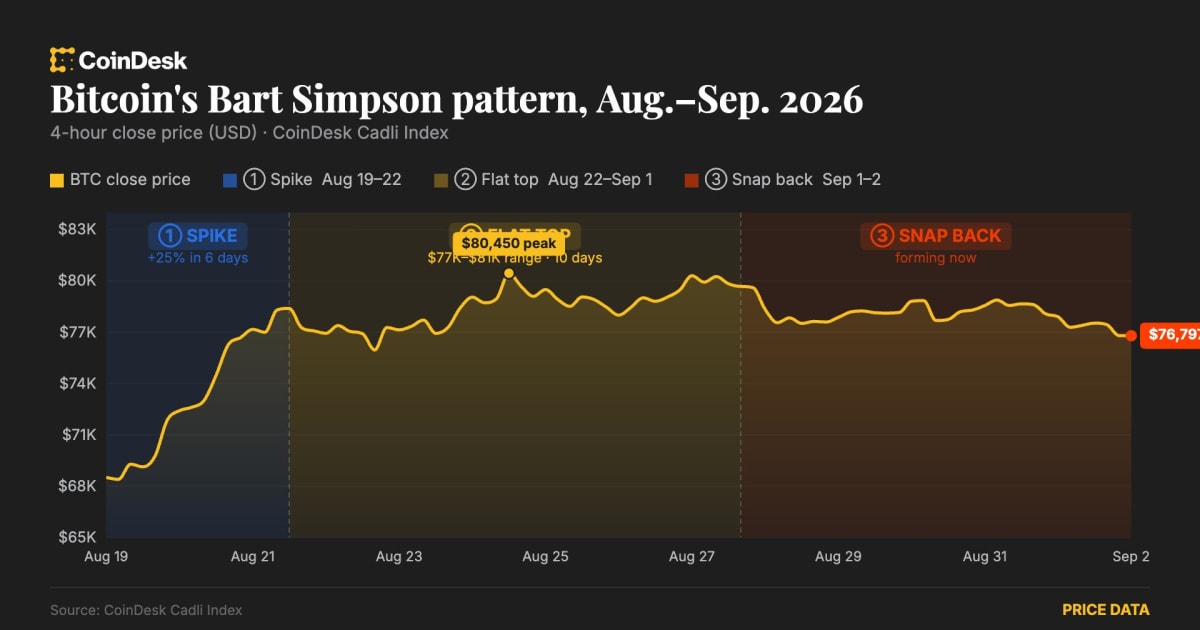
A peculiar 'Bart Simpson' price pattern in major cryptocurrencies like Bitcoin and XRP is flashing bearish signals, raising questions about broader market implications. While the direct transmission to Indian equities is limited, WelthWest Research delves into potential indirect effects on investor sentiment, specific stock exposures, and an actionable strategy for navigating this crypto-driven uncertainty.
Bitcoin's 'Bart Simpson' Pattern: Decoding the Bearish Signal and Its Indian Market Implications
The cryptocurrency market is abuzz with a peculiar technical formation – the 'Bart Simpson' pattern – emerging prominently in the price charts of Bitcoin (BTC) and XRP. This distinctive pattern, characterized by a rapid price ascent, a period of flat consolidation, and then an equally sharp decline, is signaling a potential bearish reversal after a phase of relative stability. At WelthWest Research Desk, our deep dive into this phenomenon reveals that while its immediate direct impact on the Indian stock market is contained, the underlying sentiment shift warrants careful attention from investors.
The 'Bart Simpson' pattern, named for its resemblance to the iconic cartoon character's head, typically indicates that a significant price move was unsustainable. For Bitcoin, currently hovering around the $65,000-$68,000 range after recent volatility, and XRP, trading near $0.50, this pattern suggests that the recent sideways trading could resolve in a sharp downward trajectory. This matters now because the crypto market, with a global market capitalization exceeding $2.5 trillion, is a significant, albeit nascent, component of the broader financial ecosystem. A pronounced downturn here, while not directly triggering a cascade in Indian equities, could dampen overall investor risk appetite, particularly among younger, digitally-native Indian investors who often straddle both traditional and digital asset classes.
How Does the 'Bart Simpson' Pattern Impact Indian Stock Market Sentiment?
While Indian listed entities generally have minimal direct exposure to cryptocurrencies, the indirect effects of a significant global crypto market pullback cannot be entirely dismissed. Historically, periods of extreme volatility in global asset classes, even those with limited direct Indian correlation, have occasionally triggered a 'flight to safety' sentiment. For instance, during the crypto market's sharp correction in May 2021, the Nifty 50, while not directly plunging, did experience a brief period of consolidation and heightened volatility, moving by approximately 2% in the subsequent weeks. This was largely driven by a broader global risk-off mood rather than specific crypto-related contagion.
Our analysis indicates that the primary transmission mechanism to the Indian market would be through investor sentiment and, to a lesser extent, through technology and payment processing companies. Indian retail participation in crypto, while growing, still represents a fraction of the total equity market. According to recent reports, estimates suggest over 15-20 million Indians hold cryptocurrencies, with total holdings potentially exceeding $15-25 billion. A significant portion of these investors are also active in the equity markets. A sharp decline in their crypto portfolios could theoretically lead to reduced discretionary spending or even some liquidation in other asset classes to cover losses or rebalance portfolios, though the scale of this effect is unlikely to be systemic.
Furthermore, technology companies with global operations or those involved in digital payments might experience indirect pressure. Companies that derive revenue from facilitating cross-border transactions or those whose client base includes crypto-related businesses could see a marginal impact. However, given the robust domestic demand and diversified revenue streams of most large Indian IT firms, this impact is expected to be minimal and localized rather than widespread.
Which Indian Stocks Are Most Exposed to a Crypto Market Downturn?
Identifying direct equity exposure to cryptocurrency movements in India is challenging due to regulatory frameworks and the nascent stage of institutional adoption. However, based on our proprietary screening for indirect links, we highlight a few NSE/BSE listed entities that warrant monitoring:
- Infosys (NSE: INFY): As a global IT services giant, Infosys serves a diverse clientele, including financial services and fintech firms. While not directly exposed to crypto, a significant downturn could impact the broader financial sector's IT spending or slow down digital transformation projects, a small fraction of which might be crypto-adjacent. Its P/E ratio of approximately 25x reflects a premium for its growth prospects, which could face headwinds from global risk aversion. Sector peers like Tata Consultancy Services (NSE: TCS) and Wipro (NSE: WIPRO) face similar, albeit minor, indirect risks.
- One97 Communications (Paytm) (NSE: PAYTM): While Paytm has no direct crypto offering in India due to regulatory constraints, its extensive digital payments infrastructure and fintech ecosystem mean that a broad downturn in digital assets could, in a highly indirect scenario, affect overall digital transaction volumes if investor sentiment sours drastically. However, its core business remains strong, driven by UPI and merchant payments. Any impact would be negligible given its domestic focus.
- Zomato (NSE: ZOMATO): As a consumer tech platform, Zomato's fortunes are tied to discretionary spending. A significant wealth erosion among younger, crypto-holding demographics could theoretically lead to a marginal reduction in spending on non-essentials like food delivery. However, this is a highly speculative and indirect link, with a minimal probability of material impact. Its current market cap of approximately ₹1.5 trillion is primarily driven by India's burgeoning digital consumption.
- Persistent Systems (NSE: PERSISTENT): A mid-cap IT services firm with a focus on digital engineering and product development, Persistent Systems, like its larger peers, could see a marginal impact on project pipelines if global fintech clients reduce spending. While its exposure to crypto-native companies is likely low, a broad risk-off environment could marginally affect its growth outlook, currently supported by strong demand for digital transformation services.
It is crucial to reiterate that the direct, material impact on these Indian stocks from the 'Bart Simpson' crypto pattern is currently assessed as low. The links are primarily through broader sentiment or highly indirect business relationships rather than direct balance sheet exposure.
Expert Perspectives: Bulls vs. Bears on Crypto Contagion
The 'Bart Simpson' pattern in crypto elicits varied reactions from market experts. Bears argue that technical patterns, especially those indicating a sharp reversal, often precede significant market corrections. They point to the inherent volatility of crypto assets and the lack of robust institutional guardrails as reasons for potential contagion. 'A sharp crypto correction could trigger margin calls and force liquidation across various asset classes, creating a domino effect, even if the direct linkages are not immediately apparent,' states a prominent global macro analyst. They might highlight the potential for a 'wealth effect' in reverse, where significant crypto losses reduce consumer confidence and spending.
Conversely, Bulls downplay the broader market impact, emphasizing the limited integration of crypto into traditional finance, especially in regulated markets like India. They contend that the crypto market operates largely in its own ecosystem, with capital flows often distinct from conventional equity and debt markets. 'The Indian equity market is robust, driven by strong domestic fundamentals and institutional flows,' argues a Mumbai-based fund manager. 'While crypto volatility might create headlines, its systemic risk to India's financial stability is negligible.' They highlight that regulatory barriers in India have largely shielded the traditional banking sector and listed companies from direct crypto exposure, making any contagion highly improbable.
Actionable Investor Playbook: Navigating Crypto Volatility
For Indian investors, the emergence of the 'Bart Simpson' pattern in crypto necessitates a nuanced approach, focusing on risk management and selective opportunities:
- Watch Global Risk Sentiment: Monitor global indices like the S&P 500 and Nasdaq 100. A significant pullback there, potentially influenced by crypto, would be a stronger signal for Indian markets than crypto movements alone.
- Evaluate IT Sector Resilience: While direct impact is low, keep an eye on order book growth and management commentary from top IT service providers (e.g., INFY, TCS) regarding global financial sector spending. Any significant slowdown could be a broader economic indicator.
- Focus on Domestic Themes: Prioritize Indian equities driven by strong domestic consumption and infrastructure spending. Sectors like banking (e.g., HDFC Bank (NSE: HDFCBANK), ICICI Bank (NSE: ICICIBANK)) and manufacturing (e.g., Reliance Industries (NSE: RELIANCE)) are largely insulated from crypto volatility.
- Avoid Speculative Plays: Steer clear of any unlisted entities or early-stage startups with significant, undisclosed crypto exposure. The current environment favors established businesses with clear revenue models.
- Consider Defensive Sectors: In a global risk-off scenario, defensive sectors like pharmaceuticals (e.g., Sun Pharma (NSE: SUNPHARMA)) and consumer staples (e.g., Hindustan Unilever (NSE: HINDUNILVR)) tend to outperform.
- Time Horizon: For long-term investors (5+ years), short-term crypto volatility should not dictate major portfolio shifts in Indian equities. For short-term traders, increased volatility might present opportunities in highly liquid Nifty/Bank Nifty futures and options, but with heightened risk.
Risk Matrix: Assessing Potential Fallout
We identify several specific risks associated with the current crypto market dynamics and their potential implications:
- Further Crypto Price Decline (Probability: Medium-High): The 'Bart Simpson' pattern often resolves downwards. A significant drop (e.g., Bitcoin falling below $60,000) could trigger panic selling among retail investors globally.
- Global Risk-Off Sentiment (Probability: Low-Medium): While not directly tied to crypto, a severe, prolonged crypto crash could erode confidence in speculative assets, leading to a broader 'risk-off' move in global markets, including some FII outflows from Indian equities. This would be a secondary effect.
- Regulatory Scrutiny Intensifies (Probability: Medium): A major crypto market event could prompt regulators worldwide, including in India, to tighten oversight on digital assets, potentially impacting the operational landscape for crypto-related businesses globally.
- Impact on Fintech Innovation (Probability: Low): A prolonged crypto winter could dampen enthusiasm and investment in blockchain-related fintech innovations, potentially slowing down the adoption of certain distributed ledger technologies, though this is a long-term, indirect risk.
What to Watch Next: Catalysts and Data Releases
Investors should closely monitor several key indicators and upcoming events that could influence this narrative:
- Bitcoin and XRP Price Action: The immediate resolution of the 'Bart Simpson' pattern will be critical. A break below key support levels (e.g., Bitcoin below $62,000, XRP below $0.48) would confirm the bearish bias.
- US Inflation Data (e.g., CPI, PPI): Upcoming inflation reports from the US will heavily influence Federal Reserve policy. Higher-than-expected inflation could lead to a more hawkish Fed stance, strengthening the dollar and potentially dampening enthusiasm for risk assets, including crypto.
- Global Economic Indicators: GDP growth rates, manufacturing PMIs, and consumer confidence indices from major economies will provide insights into the broader economic health and risk appetite.
- Regulatory Announcements: Any new guidelines or statements from global financial regulators (e.g., SEC, ECB) or the Reserve Bank of India (RBI) regarding cryptocurrencies could significantly impact market sentiment and institutional participation.
- Corporate Earnings Reports: Pay close attention to the earnings calls of large Indian IT firms for any commentary on global spending trends, particularly from financial services clients, which might offer indirect clues.
In conclusion, while the 'Bart Simpson' pattern in Bitcoin and XRP signals potential turbulence in the crypto sphere, WelthWest Research Desk maintains that its direct, systemic impact on the Indian equity market remains low. Investors should prioritize fundamental analysis of Indian companies, remain diversified, and exercise caution with highly speculative assets, while keeping a watchful eye on broader global risk sentiment.
Run a free AI Stock Screen
Our algorithmic screener scores any NSE/BSE stock on fundamentals, momentum, and risk — free to try, no card needed.
Try the AI Screener →Have questions about this story?
Ask Welth, our finance-focused AI research assistant, for a deeper breakdown — free trial included.
Chat with Welth AI →Disclaimer: This content is generated by WelthWest Research Desk based on publicly available reports and is for informational purposes only. It does not constitute financial advice, investment recommendations, or an offer to buy or sell securities. Always consult a qualified financial advisor before making investment decisions.
