Key Takeaway
Bitcoin's recent price retreat and the potential MSCI exclusion of a major crypto-exposed entity underscore rising regulatory scrutiny and global risk aversion. While direct Indian market exposure is minimal, this could subtly influence FII sentiment towards high-growth assets and elevate compliance risks for companies with even tangential crypto ties.
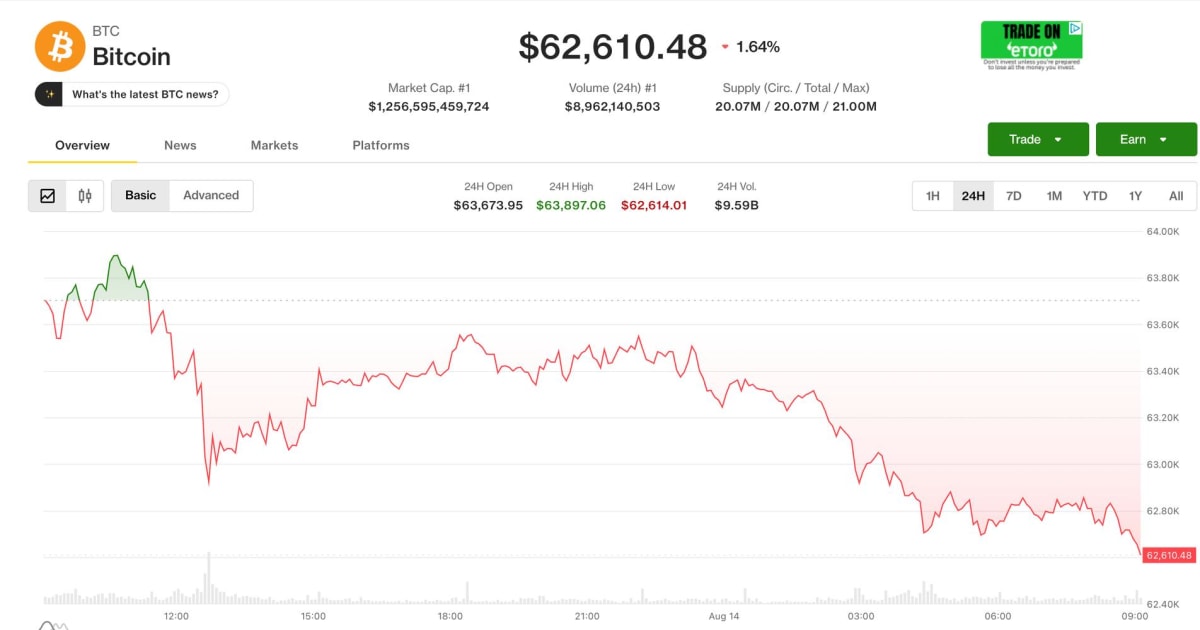
The cryptocurrency market is facing headwinds as Bitcoin slides below $63,000, compounded by MSCI's potential exclusion of a significant crypto-related firm from its indices. This confluence of events signals a broader bearish shift and heightened regulatory focus. Our deep dive explores the indirect implications for Indian stock investors, examining potential FII flow shifts and the evolving landscape for speculative asset classes.
Bitcoin's Tumultuous Slide: Unpacking the Global Crypto Contagion and Its Shadow on Indian Equities
The cryptocurrency market, often a bellwether for global risk appetite, is once again flashing warning signals. Bitcoin, the digital gold standard, recently breached the psychologically significant $63,000 mark, a move that sent ripples of concern across the digital asset landscape. Compounding this price action is the looming threat from MSCI, a titan in global index provision, which has signaled potential exclusion for a prominent crypto-centric entity from its widely followed indices. This dual blow – a significant price correction coupled with a major institutional re-evaluation – is far more than just another volatile day in crypto. It represents a potent cocktail of increased regulatory scrutiny, a shift in institutional perception, and a broader bearish sentiment that, while not directly impacting India's nascent crypto market, casts a long shadow over global investor confidence and, by extension, FII flows into Indian equities.
The immediate 'what happened' is clear: Bitcoin's price discovery below $63,000 marks a retreat from recent highs, reflecting a confluence of factors including profit-taking, macroeconomic uncertainty, and a cautious stance from institutional players. The MSCI development, while specific to one entity, serves as a powerful proxy for the growing importance of regulatory compliance and ESG (Environmental, Social, and Governance) considerations for any company with significant crypto exposure. For a company to be deemed unworthy of inclusion in an MSCI index implies a fundamental misalignment with mainstream investment criteria, potentially triggering a cascade of divestments from passive and active funds alike. This is not merely a technical adjustment; it's a statement about the evolving risk profile of crypto-related businesses in the eyes of traditional finance.
Why does this matter now? The current market juncture is characterized by elevated inflation concerns, ongoing geopolitical tensions, and central banks navigating a delicate balance between growth and price stability. In such an environment, speculative assets like cryptocurrencies often bear the brunt of de-risking efforts. The perceived 'safety' of traditional assets increases, while the allure of high-beta plays diminishes. For India, a market heavily reliant on foreign institutional investor (FII) capital, global shifts in risk sentiment are never inconsequential. While direct Indian exposure to crypto is limited by regulatory frameworks, the indirect impact on investor psychology and capital allocation strategies cannot be overlooked.
How Will Global Crypto Turmoil Affect Indian Stock Market Sentiment?
The Indian stock market, despite its relative insulation from direct cryptocurrency exposure, is not immune to global risk aversion. When major global indices re-evaluate the inclusion of crypto-linked entities, or when a flagship asset like Bitcoin experiences a significant downturn, it triggers a broader re-assessment of risk across asset classes. This phenomenon, often termed 'contagion' in financial markets, operates through psychological channels and FII allocation decisions.
Historically, periods of heightened global risk aversion, such as the taper tantrum of 2013 or the initial phases of the COVID-19 pandemic in early 2020, have seen FIIs reduce their exposure to emerging markets, including India. While the current crypto downturn is not on the scale of a global financial crisis, it contributes to a narrative of increasing market uncertainty. For instance, during the significant crypto market correction in May 2021, when Bitcoin plunged over 30% in a week, the Nifty 50, while not directly impacted by crypto, experienced increased volatility and some FII outflows in subsequent weeks as global risk assets were re-priced. While correlation is not causation, it highlights the interconnectedness of global capital flows.
Specific data points reinforce this: in periods of heightened global uncertainty, FIIs often gravitate towards less volatile, more liquid assets, and sometimes repatriate capital. A sustained bearish sentiment in crypto could lead to a marginal but noticeable shift in FII portfolio allocations, potentially reducing inflows into Indian equities, particularly those in high-growth or more speculative sectors. Conversely, sectors perceived as defensive or those with strong domestic demand drivers might see relative resilience. The 'fear factor' associated with a major asset class like crypto losing significant value can make investors globally more cautious, leading to a general de-risking across portfolios, even if the underlying assets are uncorrelated.
From a sector-level perspective, while no Indian sector is directly 'crypto-exposed' in the way a global blockchain technology firm might be, sectors that attract speculative capital or are highly dependent on global liquidity could feel an indirect pinch. This includes certain segments of the IT sector, particularly those with global client bases, and potentially some high-growth consumer discretionary stocks that thrive in an environment of abundant capital and strong risk appetite. The broader 'risk-on, risk-off' pendulum often swings in sync, and crypto's current woes suggest a tilt towards 'risk-off'.
Which Indian Stocks Could Feel the Ripple Effect of Crypto Volatility?
While no direct crypto-mining or exchange-listed companies exist on the NSE/BSE, the indirect impact on investor sentiment, particularly from FIIs, can affect certain Indian stocks. We identify 4-6 specific NSE/BSE stocks and sectors that could experience a subtle shift in investor perception or FII flows:
- Info Edge (India) Ltd. (NSE: NAUKRI): As a prominent player in India's internet and new-economy space, Info Edge, through its investments in Zomato and PolicyBazaar, often serves as a proxy for investor appetite for high-growth, technology-driven businesses. A global downturn in speculative assets like crypto might dampen investor enthusiasm for companies with high growth multiples and longer paths to profitability, even if their underlying businesses are robust. Its P/E ratio, often reflecting future growth potential, could see some pressure if global tech valuations recalibrate downwards. Sector peers like FSN E-Commerce Ventures (NSE: NYKAA) and PB Fintech (NSE: PBFINTECH) could also face similar sentiment-driven headwinds.
- Tata Consultancy Services Ltd. (NSE: TCS): While a fundamentally strong IT services giant, TCS, like other large-cap IT firms, derives a significant portion of its revenue from global clients. A general atmosphere of global economic uncertainty and de-risking, partially fueled by crypto's woes, could lead to a cautious outlook on IT spending by global corporations. While not a direct impact, a subtle shift in FII allocation away from emerging market IT could affect its valuation multiples. Sector peers such as Infosys (NSE: INFY) and Wipro (NSE: WIPRO) could also experience this indirect pressure.
- HDFC Bank Ltd. (NSE: HDFCBANK): As India's largest private sector bank and a bellwether for the financial sector, HDFC Bank's performance is closely tied to FII sentiment. While its core business is insulated from crypto, a broader risk-off environment can lead to FII outflows from Indian equities, including leading financial institutions. This could manifest as subdued buying interest or even marginal selling pressure, affecting its stock price. Its sheer market capitalization and liquidity make it a primary target for FII rebalancing. Peer banks like ICICI Bank (NSE: ICICIBANK) would also be subject to similar FII flow dynamics.
- Reliance Industries Ltd. (NSE: RELIANCE): A conglomerate with diverse interests, including energy, retail, and digital services, Reliance is a heavyweight in the Indian market. While its traditional businesses provide stability, its newer digital ventures (Jio Platforms) have attracted significant global tech investments, often driven by a 'growth at all costs' mentality. A shift in global risk appetite, influenced by crypto's struggles, could temper enthusiasm for high-growth digital plays and potentially impact valuations for future fundraises or strategic partnerships.
Bitcoin's Bearish Signal: A Contrarian Viewpoint
The current crypto downturn elicits predictable arguments from both bulls and bears. Bears would contend that Bitcoin's inability to hold critical support levels, coupled with institutional threats like MSCI's, validates their long-held belief that cryptocurrencies are inherently speculative, lacking intrinsic value, and vulnerable to regulatory whims. They would point to the 'greater fool theory' and argue that the current correction is merely a return to fundamental valuations, suggesting further downside is likely. For them, this is a clear signal to de-risk from any asset class perceived as speculative, including high-growth Indian tech stocks that trade at premium valuations.
Bulls, however, would offer a contrarian perspective, viewing this correction as a healthy shakeout, a necessary cleansing of overleveraged positions and weak hands. They would argue that Bitcoin's underlying blockchain technology and its role as a decentralized, censorship-resistant asset remain fundamentally strong. They might highlight previous corrections – the 2018 'crypto winter' or the 2021 flash crash – as opportunities that ultimately led to stronger rallies. For institutional adoption, they would argue that regulatory clarity, even if initially restrictive, provides a framework for long-term growth. From an Indian market perspective, they might see any FII outflows as temporary, presenting buying opportunities in fundamentally strong Indian companies that have been unfairly penalized by global sentiment. They might even argue that crypto's independence from traditional financial systems makes it a hedge against central bank policies, a narrative that gains traction during periods of inflation.
A balanced perspective acknowledges that the crypto market is maturing, and with maturity comes greater scrutiny. The MSCI threat, in particular, highlights that traditional finance is demanding adherence to established norms, a process that will inevitably cause friction but could ultimately lead to a more robust, albeit regulated, digital asset ecosystem. For Indian investors, the key is to discern between temporary sentiment shifts and fundamental changes in the global economic landscape.
Actionable Investor Playbook: Navigating Crypto's Ripples in Indian Equities
Given the indirect nature of the impact, Indian investors need a nuanced playbook to navigate the current environment. This isn't a call for panic, but rather a prompt for strategic re-evaluation:
- Watch for FII Flow Reversals: Keep a close eye on daily FII investment data from the NSDL. A sustained period of net outflows, especially from the equity segment, could indicate a broader de-risking trend impacting the Nifty and Sensex. If FIIs begin to consistently pull out capital, it's a signal to become more cautious on high-beta segments.
- Re-evaluate High-Growth, High-Valuation Stocks: Companies in the internet, SaaS, and certain consumer discretionary sectors that trade at elevated P/E multiples (e.g., above 50x earnings for established players) might face valuation compression if global risk appetite diminishes. Consider trimming positions or rebalancing towards more value-oriented or defensive plays. Entry points for these stocks might emerge after a significant correction, potentially 15-20% from recent highs, but only if their underlying business fundamentals remain intact.
- Focus on Quality and Domestic Demand: Shift allocation towards companies with strong balance sheets, consistent earnings, and a significant reliance on India's domestic consumption story. Sectors like pharmaceuticals (e.g., Sun Pharmaceutical Industries Ltd. (NSE: SUNPHARMA)), select FMCG (e.g., Hindustan Unilever Ltd. (NSE: HINDUNILVR)), and capital goods (e.g., Larsen & Toubro Ltd. (NSE: LT)) could offer relative stability.
- Consider Short-Term Hedging Strategies: For sophisticated investors with significant equity exposure, consider using Nifty 50 index options for short-term hedging if global volatility escalates. Buying out-of-the-money put options can provide some downside protection against sharp market corrections.
- Long-Term Horizon for Core Holdings: For fundamentally strong Indian companies, any short-term FII-driven corrections present opportunities for long-term accumulation. The Indian growth story remains robust, and temporary global sentiment shifts rarely alter long-term trajectories for quality businesses.
Risk Matrix: Assessing the Probability of Indirect Impact
While direct impact is low, the indirect risks stemming from the crypto market's turbulence are worth assessing:
-
Risk 1: Sustained FII Outflows from Indian Equities (Medium Probability):
If the global risk-off sentiment intensifies due to further crypto declines, escalating geopolitical tensions, or hawkish central bank actions, FIIs might systematically reduce their exposure to emerging markets. This could lead to a sustained period of selling pressure on the Nifty and Sensex, impacting a broad range of stocks. The probability is assessed as medium, as India's domestic growth story often acts as a counterweight.
-
Risk 2: Valuation Compression for High-Growth Indian Tech Stocks (Medium-High Probability):
The 'growth at any cost' narrative, often associated with tech and speculative assets, is being challenged globally. If this trend continues, Indian internet and new-age tech companies, which often trade at rich valuations, could see their multiples contract as investors become more discerning about profitability and cash flows. This risk is higher for companies yet to achieve consistent profitability.
-
Risk 3: Increased Regulatory Scrutiny on Crypto-Adjacent Ventures (Low-Medium Probability):
Globally, regulators are tightening their grip on crypto. While India's stance has been cautious, any major global regulatory crackdown could indirectly influence the Indian government's approach to blockchain technology or any company perceived to have crypto-adjacent activities, even if not directly involved in trading. This could manifest as delays in policy clarity or increased compliance burdens for firms exploring Web3 technologies.
-
Risk 4: Broader Global Economic Slowdown (Medium Probability):
A significant downturn in the crypto market, if it coincides with other macroeconomic stressors (e.g., a recession in major economies, persistent inflation), could signal a broader global economic slowdown. This would inevitably impact Indian export-oriented sectors and overall corporate earnings, irrespective of crypto's direct influence. The crypto market often acts as a canary in the coal mine for global liquidity conditions.
What to Watch Next: Catalysts for the Crypto and Indian Market Narrative
Several upcoming catalysts and data releases will shape this evolving narrative:
- MSCI's Final Decision on Index Exclusion: The ultimate decision and its rationale will provide crucial insights into how traditional finance views crypto-exposed entities. A definitive exclusion could set a precedent for other index providers and institutional investors.
- US CPI and Fed Interest Rate Decisions: Global macroeconomic data, particularly inflation figures and central bank responses from the US Federal Reserve, will heavily influence global risk appetite. Hawkish stances could further dampen enthusiasm for speculative assets like crypto and potentially impact FII flows to emerging markets. The next FOMC meeting minutes and subsequent rate decisions are critical.
- Earnings Reports of Global Tech Giants: The performance of major global technology companies, particularly those involved in digital payments or cloud infrastructure, can serve as a proxy for the health of the broader 'new economy' and investor sentiment towards growth stocks, indirectly influencing Indian tech valuations.
- Indian Q1 FY25 Corporate Earnings: Upcoming quarterly earnings from Indian companies will provide insights into domestic demand resilience and corporate profitability. Strong earnings could help cushion the market against global headwinds, while weak results might exacerbate FII selling.
- Regulatory Developments in Major Jurisdictions (EU, US): Any new legislative frameworks or enforcement actions concerning cryptocurrencies in key global markets will be closely watched. Increased clarity, even if restrictive, can sometimes reduce uncertainty, while outright bans or severe penalties could trigger further market instability.
Run a free AI Stock Screen
Our algorithmic screener scores any NSE/BSE stock on fundamentals, momentum, and risk — free to try, no card needed.
Try the AI Screener →Have questions about this story?
Ask Welth, our finance-focused AI research assistant, for a deeper breakdown — free trial included.
Chat with Welth AI →Disclaimer: This content is generated by WelthWest Research Desk based on publicly available reports and is for informational purposes only. It does not constitute financial advice, investment recommendations, or an offer to buy or sell securities. Always consult a qualified financial advisor before making investment decisions.
