Key Takeaway
Bitcoin's recent slide and rotation into select altcoins like Bitcoin Cash (BCH) and Zcash (ZEC) signals a cautious shift in speculative asset appetite. While direct impact on Indian financial markets is minimal, this trend warrants monitoring for its potential to influence broader investor sentiment and Foreign Institutional Investor (FII) flows.
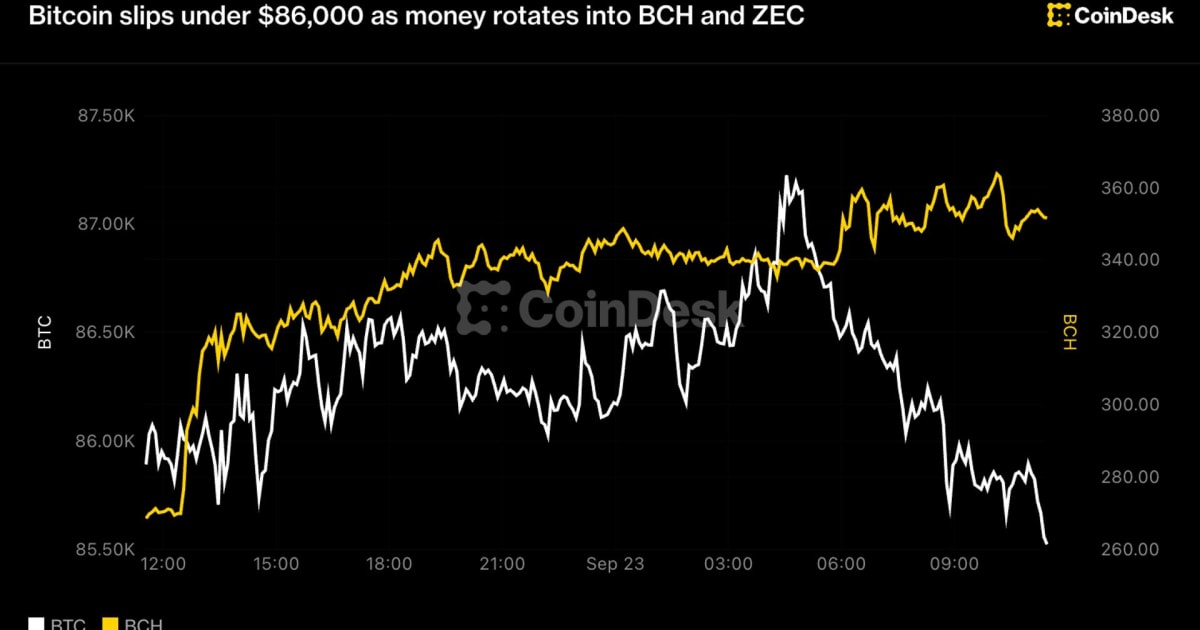
Bitcoin's sharp decline and subsequent rotation into niche altcoins have captured global market attention. This analysis unpacks the 'why' and 'how' of this phenomenon, critically examining its nascent yet important implications for India's equity landscape, from investor sentiment to specific sector impacts.
Bitcoin's Price Plunge and the Altcoin Rotation: A New Signal for Indian Investors?
In a dramatic turn of events that has sent ripples through the digital asset ecosystem, Bitcoin (BTC), the undisputed king of cryptocurrencies, has experienced a significant price correction. This downturn, however, has not led to a wholesale exodus from the crypto market. Instead, it has triggered a notable rotation of capital into smaller, often more speculative, altcoins, most prominently Bitcoin Cash (BCH) and Zcash (ZEC). While the immediate, direct contagion effect on India's traditional stock markets may appear negligible, this shift in investor behavior within the burgeoning cryptocurrency space offers crucial insights into evolving risk appetites, potentially influencing broader market sentiment and the flow of speculative capital, including Foreign Institutional Investor (FII) flows into India.
Why This Bitcoin Downturn Matters Now for Global and Indian Markets
The cryptocurrency market, despite its relative youth, is increasingly intertwined with global financial narratives. Bitcoin's price movements often serve as a bellwether for speculative asset sentiment. When Bitcoin, with its substantial market capitalization (recently hovering around $1.3 trillion USD before this correction), experiences volatility, it draws attention. The subsequent rotation into altcoins like Bitcoin Cash (BCH) and Zcash (ZEC) is not merely a technical trading pattern; it signifies a dynamic reallocation of risk. Investors, perhaps sensing an overvaluation in Bitcoin or seeking higher potential, albeit riskier, returns, are moving their capital. This behavior is analogous to shifts seen in equity markets where investors might move from large-cap, stable stocks to mid-cap or small-cap growth stocks during periods of heightened optimism or when seeking alpha. For India, a nation increasingly participating in global capital flows and witnessing a rise in its own retail and institutional investment in alternative assets, understanding these global crypto dynamics is becoming less of a niche concern and more of a strategic imperative.
Deep Market Impact Analysis: Connecting Crypto Shifts to Indian Equities
The direct correlation between Bitcoin's price and the Nifty 50 or Sensex is not a linear one. Indian equity markets are primarily driven by domestic economic factors, corporate earnings, and the Reserve Bank of India's (RBI) monetary policy. However, the indirect channels are significant. A sustained downturn in major cryptocurrencies can reflect a broader aversion to risk across asset classes. If global investors perceive cryptocurrencies as a significant, albeit nascent, alternative investment class, a substantial crypto sell-off could lead to a general tightening of liquidity and a pull-back from riskier assets worldwide, including emerging markets like India. Historically, periods of global risk-off sentiment, often triggered by macroeconomic shocks or geopolitical instability, have seen FIIs reduce their exposure to Indian equities. While the current Bitcoin correction is not on the scale of a systemic financial crisis, it occurs within a context of elevated global inflation and interest rate hikes, making it a relevant indicator of investor sentiment. If the narrative around digital assets shifts from 'high growth potential' to 'high risk and volatility,' it could subtly dampen enthusiasm for other speculative ventures, including some segments of the Indian startup ecosystem or even high-growth technology stocks on the NSE and BSE.
Furthermore, the rise of Bitcoin Cash (BCH) and Zcash (ZEC) during Bitcoin's decline highlights the speculative nature of altcoin markets. These smaller-cap cryptocurrencies are often more volatile and can experience exaggerated price swings. Their outperformance suggests a search for higher returns in a volatile environment, a behavior mirrored in the Indian stock market during periods of speculative fervor, where small-cap and micro-cap stocks often see disproportionate gains when sentiment is bullish. Conversely, when sentiment sours, these same stocks are the first to fall. The current altcoin rotation, therefore, could be seen as a microcosm of broader risk-taking behavior that, if amplified, could spill over into traditional markets.
How Will RBI Policy Decisions Influence Indian Stock Market Sentiment Amidst Global Crypto Volatility?
The Reserve Bank of India's (RBI) stance on monetary policy remains a paramount driver for Indian equities. Any indication of interest rate hikes or prolonged high rates can increase the cost of capital, impacting corporate profitability and making fixed-income investments more attractive relative to equities. In a scenario where global risk sentiment is already weakened by events like the Bitcoin correction, a hawkish RBI stance could exacerbate the sell-off in Indian equities, particularly in growth-oriented stocks that are more sensitive to interest rate changes. Conversely, any dovish signals, even amidst global volatility, could provide a cushion for the Indian market. Investors will be closely watching the RBI's commentary for cues on future policy direction, as this will be a more direct influence on domestic stock prices than the immediate crypto price action.
Stock-by-Stock Breakdown: Identifying Potential Impacts on Indian Listed Companies
While no Indian companies are directly involved in Bitcoin mining or hold significant Bitcoin reserves in the way some global tech firms do, the indirect impacts can manifest in several ways:
- Companies with Digital Asset Exposure (Indirect): While direct holdings are rare on Indian exchanges, companies that have diversified into blockchain technology or have investments in startups with crypto-related business models could see sentiment shifts. For instance, if a company like Info Edge (India) Ltd. (NSE: INFOED), which has investments in various internet ventures, were to have exposure to a blockchain-focused startup, its valuation could be indirectly affected by the broader digital asset market sentiment. Its current P/E ratio (as of late 2023) hovers around 70-80, indicating a growth-oriented valuation that is sensitive to market sentiment.
- Fintech and Payment Service Providers: Companies that operate in the digital payments space, such as Paytm (NSE: PAYTM), might see a subtle impact. A general increase in caution towards speculative digital assets could translate into a more conservative approach towards new, untested payment technologies. While Paytm's core business is not crypto, a broader market fear of 'digital risk' could affect investor confidence in its valuation, which has historically been volatile, trading at a Price-to-Sales ratio that reflects high growth expectations.
- Technology and Software Services Companies: Companies like Tata Consultancy Services (TCS) (NSE: TCS) or Infosys (NSE: INFY), with significant revenue from global clients, could experience a marginal impact if their clients' overall IT spending budgets are affected by a global economic slowdown that is partly signaled by risk-asset corrections. However, their diversified revenue streams and strong order books (TCS's TTM revenue exceeded ₹2.3 trillion) generally provide resilience. Their P/E ratios (around 25-30 for TCS and Infosys) are more reflective of stable growth and profitability.
- Companies with High Retail Investor Participation: In periods of heightened speculative activity, retail investors often chase high-beta stocks. If a general risk-off sentiment takes hold due to global events like the crypto downturn, these investors might pull back from such stocks. Companies with a significant portion of their market cap held by retail investors, often found in the small and mid-cap segments, could experience increased volatility. For example, a company like Reliance Industries Ltd. (NSE: RELIANCE), while a large-cap behemoth with diverse interests, has seen significant retail investor interest. Any broad market sentiment shift could impact its stock price, though its fundamental strength (TTM revenue over ₹8 lakh crore) offers substantial support.
- Niche Technology and Gaming Companies: Any Indian listed company with even a tangential exposure to the blockchain gaming or NFT space, however small, would be highly sensitive to crypto sentiment. Such companies, if they exist and are publicly traded, would likely have very high P/E ratios, reflecting their speculative nature.
Expert Perspective: Bulls vs. Bears on the Bitcoin Rotation
Bullish Argument: Proponents of cryptocurrencies would argue that this is a healthy market correction and a natural maturation process. They would point to the rotation into Bitcoin Cash (BCH) and Zcash (ZEC) as evidence of a more sophisticated investor base seeking specific use cases or undervalued digital assets. They might suggest that Bitcoin's dominance waning slightly in favor of altcoins indicates a broader, more robust crypto ecosystem, rather than a sign of weakness. For Indian investors, bulls would emphasize that the long-term adoption of blockchain technology and digital assets is inevitable, and any dips present a buying opportunity for those with a long-term horizon, potentially leading to future gains in companies that embrace this technology.
Bearish Argument: Skeptics and bears, on the other hand, would interpret this as a clear sign of increasing volatility and risk within the crypto market. They would highlight that Bitcoin Cash (BCH) and Zcash (ZEC) are significantly more volatile and less established than Bitcoin, making their outperformance a signal of speculative frenzy rather than fundamental strength. Bears would caution that this rotation is a precursor to a broader market downturn, where investors are fleeing from one risky asset to another, potentially leading to contagion effects. For India, they would warn that any increase in speculative capital flows into crypto, even indirectly, could divert funds from more productive investments in the domestic equity market and increase systemic risk.
Actionable Investor Playbook: Navigating the Crypto-Equity Nexus
For the discerning Indian investor, navigating the interplay between global crypto movements and domestic equity markets requires a nuanced approach:
- Monitor FII Flows Closely: Keep a keen eye on daily FII investment data for Indian equities. A significant and sustained pull-back in FII investment, coinciding with global risk-asset sell-offs (including crypto), would be a strong bearish signal for Indian markets.
- Focus on Fundamentals, Not Hype: For Indian stocks, prioritize companies with strong balance sheets, consistent earnings growth, and robust business models. Avoid chasing narratives driven by speculative asset classes. For example, instead of looking at speculative tech stocks, consider established players like HDFC Bank (NSE: HDFCBANK), whose P/E ratio (around 20-22) reflects its stable, dominant position in the banking sector, or diversified conglomerates like Larsen & Toubro (NSE: LT), with its strong infrastructure order book.
- Consider Diversification within Equities: If you are invested in growth stocks or mid-cap companies, ensure your portfolio is adequately diversified across sectors. A balanced approach, potentially including value stocks and defensive sectors like pharmaceuticals (e.g., Sun Pharmaceutical Industries Ltd. (NSE: SUNPHARMA), with a TTM revenue of over ₹40,000 crore and a P/E of around 18-20), can mitigate risks associated with broad market downturns.
- Cautious Approach to Crypto-Adjacent Investments: If considering Indian companies with any direct or indirect exposure to blockchain or digital assets, conduct thorough due diligence. Understand the specific revenue streams and the true extent of their involvement. Entry points for such speculative plays should be approached with extreme caution, perhaps only with a small portion of capital that one is prepared to lose entirely.
- Time Horizon: Short-Term vs. Long-Term: The Bitcoin rotation is a short-term phenomenon. Its impact on Indian equities will likely be indirect and sentiment-driven, primarily affecting speculative segments. Long-term investors in quality Indian companies should remain focused on their investment thesis, as short-term global volatility often presents buying opportunities.
Risk Matrix: Quantifying Potential Downside
The risks associated with this crypto-equity nexus are multifaceted:
- Regulatory Uncertainty (Probability: High): The regulatory landscape for cryptocurrencies globally and in India remains fluid. Sudden regulatory crackdowns or pronouncements can trigger sharp price declines and impact investor sentiment towards digital assets and related technologies.
- Contagion Effect on Speculative Assets (Probability: Medium): A severe and prolonged downturn in the crypto market could spill over into other speculative asset classes, including high-growth tech stocks and venture capital-backed startups in India, leading to a broader de-rating of such assets.
- Shift in FII Sentiment (Probability: Medium-Low): If global investors begin to view cryptocurrencies as a significant alternative investment class and experience substantial losses, it could lead to a general reduction in risk appetite for emerging markets, impacting FII inflows into India.
- Algorithmic Trading Amplification (Probability: Low-Medium): In highly liquid markets, algorithmic trading can amplify price movements. A significant event in one asset class could trigger automated selling in correlated or sentiment-linked assets, potentially leading to unexpected volatility in Indian equities.
What to Watch Next: Upcoming Catalysts and Data Releases
The unfolding narrative of crypto volatility and its potential impact on Indian markets will be shaped by several key factors:
- Global Inflation Data: Key inflation reports from major economies (US CPI, Eurozone HICP) will dictate the pace of global interest rate hikes, influencing risk appetite worldwide.
- RBI Monetary Policy Statements: Any upcoming announcements or minutes from the RBI's Monetary Policy Committee meetings will be crucial for understanding the domestic interest rate outlook and its impact on Indian equities.
- FII Investment Data: Daily and weekly foreign institutional investor inflow/outflow data for Indian equities will serve as a real-time indicator of global investor sentiment towards India.
- Major Cryptocurrency News and Regulatory Developments: Significant news regarding regulatory actions, institutional adoption, or major technological developments within the cryptocurrency space can influence global crypto prices and, by extension, broader market sentiment.
- Earnings Season for Indian Tech and Fintech Companies: Upcoming quarterly earnings reports from Indian IT services giants and fintech players will provide insights into their performance and outlook, factoring in any global economic headwinds or tailwinds.
While the immediate connection between Bitcoin's price action and the Nifty 50 might seem tenuous, the underlying shift in investor sentiment and risk appetite it signals is a critical development for any seasoned investor to monitor. The digital asset revolution continues to evolve, and its echoes are increasingly felt across traditional financial landscapes, including India.
Run a free AI Stock Screen
Our algorithmic screener scores any NSE/BSE stock on fundamentals, momentum, and risk — free to try, no card needed.
Try the AI Screener →Have questions about this story?
Ask Welth, our finance-focused AI research assistant, for a deeper breakdown — free trial included.
Chat with Welth AI →Disclaimer: This content is generated by WelthWest Research Desk based on publicly available reports and is for informational purposes only. It does not constitute financial advice, investment recommendations, or an offer to buy or sell securities. Always consult a qualified financial advisor before making investment decisions.