Key Takeaway
Record Ether futures open interest coinciding with a price drop signals heightened speculative fervor, potentially increasing volatility. This divergence demands close monitoring for its subtle but significant implications on Indian IT companies with blockchain exposure and the regulatory outlook for domestic crypto exchanges.
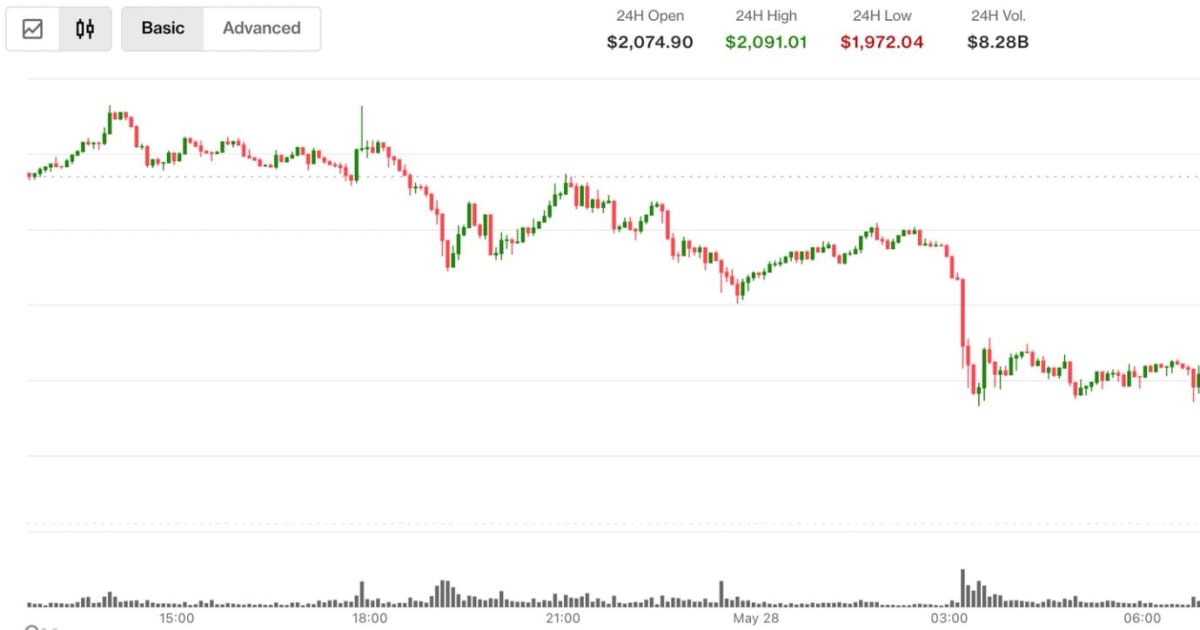
Ether's recent slip below $2,000, juxtaposed with an all-time high in futures open interest, points to a complex market dynamic driven by significant speculative bets. This unusual combination warrants a deeper examination of its potential fallout for Indian technology firms dabbling in blockchain and the future trajectory of India's nascent cryptocurrency exchange landscape.
Ether's Price Collapse Amidst Record Futures Open Interest: A Looming Threat to Indian Tech and Crypto?
The digital asset market is currently exhibiting a peculiar divergence: while the price of Ether (ETH), the second-largest cryptocurrency by market capitalization, has recently dipped below the psychologically significant $2,000 mark, the open interest in its futures contracts has concurrently surged to an unprecedented all-time high. This seemingly contradictory scenario, where a declining asset attracts record speculative engagement, is not merely an academic observation for global crypto traders; it carries tangible, albeit indirect, implications for the Indian financial ecosystem, particularly for technology companies with nascent blockchain ventures and the domestic cryptocurrency exchanges navigating an evolving regulatory environment.
What is Happening and Why Does it Matter Now?
Open interest in futures contracts represents the total number of outstanding derivative contracts that have not yet been settled. A record high in open interest, especially when coupled with a falling price, suggests a substantial increase in both long and short positions being opened, indicating a heightened level of speculative activity and potential for increased price volatility. Traders are likely taking significant directional bets, either anticipating a further price decline (shorting Ether) or betting on a sharp rebound (going long). The sheer volume of these positions amplifies the market's sensitivity to news and sentiment shifts. For Ether, which often acts as a bellwether for the broader altcoin market and has significant implications for decentralized finance (DeFi) platforms built on its blockchain, this heightened speculative posture creates a precarious environment.
This dynamic is particularly relevant now due to the increasing institutional adoption of cryptocurrencies globally and the growing, albeit still nascent, interest from Indian corporations in blockchain technology. Companies are exploring its applications in supply chain management, digital identity, and financial services. Any significant turbulence in major cryptocurrencies like Ether can lead to a broader reassessment of digital asset investments, potentially impacting R&D budgets and strategic initiatives within these Indian firms. Furthermore, the Indian regulatory bodies, including the Reserve Bank of India (RBI) and the Securities and Exchange Board of India (SEBI), have been cautiously observing the cryptocurrency space. A surge in volatility, fueled by record speculative positions, could reignite discussions about enhanced oversight and potentially stricter regulations for crypto exchanges operating in India.
Deep Market Impact Analysis: Connecting the Dots to the Indian Stock Market
The impact on the Indian stock market is primarily indirect, manifesting through two key channels: the performance of Indian IT companies with blockchain exposure and the sentiment surrounding domestic cryptocurrency exchanges. While no Indian listed company has direct, substantial holdings in Ether that would materially impact their balance sheets from a short-term price fluctuation, their strategic investments and future revenue streams linked to blockchain technology could be affected.
Indian IT Sector and Blockchain Exposure: Several Indian IT giants and mid-cap firms have been actively developing blockchain solutions for their enterprise clients. Companies like Tata Consultancy Services (TCS), Infosys, Wipro, and HCLTech have established dedicated blockchain practices. While their revenue from blockchain is still a fraction of their overall topline (often in the low single digits percentage-wise), a prolonged downturn or extreme volatility in the crypto market can dampen client enthusiasm for new blockchain projects, particularly those with a speculative or purely digital asset focus. For instance, if a client considering a blockchain-based supply chain solution sees the underlying cryptocurrency powering it become highly unstable, they might postpone or scale back their investment. This can translate into slower growth in the blockchain services segment for these IT majors. Last time major cryptocurrencies saw significant volatility in 2022, it led to a broader cautiousness in tech spending, impacting the growth outlook for the IT sector, albeit for broader macroeconomic reasons as well.
Indian Crypto Exchanges and Regulatory Scrutiny: The Indian cryptocurrency exchange landscape, comprising platforms like CoinDCX, WazirX (though its operational status has been complex due to regulatory issues), and ZebPay, is highly sensitive to both market sentiment and regulatory pronouncements. While these exchanges do not directly trade Ether in the same way global platforms do, they facilitate the trading of cryptocurrencies for Indian investors. High volatility and record speculative interest in a major asset like Ether can lead to increased trading volumes on these platforms, potentially boosting their revenue from transaction fees. However, this also brings increased risk. A significant price crash following a period of high open interest could lead to investor losses, which might, in turn, attract negative attention from regulators. Indian authorities have historically taken a cautious stance on cryptocurrencies, emphasizing consumer protection and financial stability. Any perception of excessive speculation or potential for widespread investor harm could trigger renewed regulatory scrutiny, impacting the operational freedom and future growth prospects of these exchanges.
The current situation, with record open interest at $2,000 Ether, presents a scenario where the potential for both significant profit and substantial loss is amplified. If Ether experiences a sharp downturn, it could trigger a wave of negative sentiment that spills over into the broader digital asset class, potentially slowing down adoption and investment in blockchain technologies by Indian enterprises. Conversely, a sharp rally, fueled by the unwinding of these speculative positions, could temporarily boost market sentiment.
How Will RBI Rate Decisions Influence Crypto and Related Stocks?
The Reserve Bank of India's (RBI) monetary policy decisions, particularly concerning interest rates, have a subtle yet pervasive influence on speculative assets like cryptocurrencies and the technology companies that serve them. When the RBI maintains a hawkish stance, signaling potential interest rate hikes or keeping rates elevated, it generally tightens liquidity in the financial system. This makes riskier assets, including cryptocurrencies and growth-oriented tech stocks, less attractive as investors might shift towards safer, yield-bearing instruments like fixed deposits or government bonds. Conversely, a dovish RBI stance, suggesting potential rate cuts or stable rates, can inject liquidity and encourage risk-taking, potentially benefiting both crypto markets and the IT sector. The current global inflationary environment and the RBI's focus on price stability mean that any significant loosening of monetary policy is unlikely in the short term, maintaining a backdrop of cautious liquidity which can exacerbate the impact of negative news in speculative markets.
Stock-by-Stock Breakdown: Identifying Potential Impacts
While direct listing of crypto assets on Indian stock exchanges is non-existent, the indirect impacts on specific companies and their peers are worth noting. The primary impact will be felt by entities directly or indirectly involved in the digital asset ecosystem or those with significant blockchain development initiatives.
- WazirX (Indirect Impact): Although WazirX's operational relationship with Binance has created complexities and regulatory hurdles in India, it remains a recognized name in the Indian crypto exchange space. Any significant global crypto market downturn or increased regulatory pressure on exchanges worldwide can indirectly influence the perceived risk associated with operating such platforms in India. While not directly listed, its brand recognition means its challenges can cast a shadow on the broader Indian crypto exchange sentiment.
- CoinDCX (Indirect Impact): As one of India's largest and most prominent cryptocurrency exchanges, CoinDCX's fortunes are intrinsically linked to the overall health and investor sentiment in the digital asset market. A prolonged bear market or a major crisis in the crypto space, potentially triggered by events like a sharp decline in Ether following high open interest, could lead to reduced trading volumes and a slowdown in user acquisition. While CoinDCX is privately held, its performance is indicative of the sector's health, which could influence investor appetite for other tech-focused startups or companies with crypto exposure.
- ZebPay (Indirect Impact): Another established player in the Indian crypto exchange market, ZebPay, would similarly face headwinds from a sustained crypto downturn. Reduced trading activity and a decline in investor confidence can impact revenue streams derived from transaction fees and other services. The company's ability to navigate increased regulatory scrutiny, especially if global events lead to a more cautious approach from Indian authorities, will be crucial.
- Tech Mahindra (Sector Peer - IT Services): While Tech Mahindra might have less direct blockchain project revenue compared to TCS or Infosys, its focus on emerging technologies means it is also building capabilities in this area. A general slowdown in enterprise adoption of blockchain, driven by market volatility and uncertainty in cryptocurrencies, could affect the growth rate of its digital transformation services, including blockchain-based solutions. Its P/E ratio currently stands at approximately 22x, suggesting investors have priced in growth, which could be challenged by such headwinds.
- HCLTech (Sector Peer - IT Services): HCLTech has been actively expanding its digital and blockchain offerings. The impact of Ether's price action would be through its influence on client spending for blockchain-related projects. If clients become hesitant due to crypto market instability, HCLTech's revenue growth from these specific segments could see a moderation. Its trailing twelve-month revenue is around $12.5 billion, with a P/E ratio of approximately 25x.
It's crucial to understand that these are indirect impacts. The revenue generated by Indian IT firms from blockchain services is typically a small percentage of their total revenue. For instance, if blockchain services contribute 2-3% of a company's revenue, a 10% dip in that specific segment might only lead to a 0.2-0.3% impact on overall revenue growth. However, investor sentiment often reacts to perceived risks in emerging technology sectors, and a prolonged crypto downturn could lead to a broader de-rating of IT stocks with significant blockchain ambitions.
Expert Perspective: Bulls vs. Bears on Ether's Divergence
Bulls argue: The record open interest signifies robust participation and underlying conviction from sophisticated traders who are strategically positioning themselves for a significant upward move. They might see the current price dip as a temporary correction or a 'shakeout' of weaker hands, with the high open interest reflecting a large base of traders ready to capitalize on a rebound. They might point to Ether's fundamental utility in DeFi, NFTs, and the upcoming Ethereum upgrades (like the Merge's successors) as drivers for long-term value, irrespective of short-term price action.
Bears counter: The divergence is a clear warning sign of extreme speculation and potential for a capitulation event. Record open interest, especially when coupled with declining prices, often precedes sharp sell-offs as leveraged positions are liquidated. They emphasize that the current speculative frenzy might be detached from fundamental value, driven by herd mentality and the search for quick gains. The regulatory uncertainty surrounding digital assets globally, and the macroeconomic headwinds, further amplify the downside risk.
From an Indian market perspective, the bears' view often resonates more strongly with regulators and cautious institutional investors, who are more sensitive to the risks associated with speculative assets. The bulls' arguments, however, find traction with a younger demographic of investors and tech enthusiasts who see the transformative potential of blockchain technology.
Actionable Investor Playbook: Navigating the Volatility
For investors tracking the intersection of crypto markets and Indian equities, a strategy of cautious observation and selective engagement is recommended. The current environment calls for risk management rather than aggressive positioning.
- For Indian IT Stocks with Blockchain Exposure:
- Watchlist & Accumulate on Dips: Companies like TCS (NSE: TCS, P/E ~28x), Infosys (NSE: INFY, P/E ~25x), Wipro (NSE: WIPRO, P/E ~22x), HCLTech (NSE: HCLTECH, P/E ~25x), and Tech Mahindra (NSE: TECHM, P/E ~22x) are fundamentally strong IT players. Their blockchain exposure is a growth avenue. If the broader crypto market downturn leads to irrational selling in these IT stocks, creating attractive entry points (e.g., Nifty IT index seeing a 10-15% correction from its highs), consider accumulating for a medium-to-long-term horizon (1-3 years).
- Focus on Enterprise Blockchain: Prioritize IT companies that are clearly articulating their revenue from enterprise blockchain solutions rather than those dabbling in speculative crypto-related ventures. The former has a more stable revenue stream.
- Monitor Commentary: Pay close attention to management commentary on blockchain project pipelines and client demand during quarterly earnings calls.
- For Indian Crypto Exchanges (Indirectly):
- Avoid Direct Investment: Given the regulatory uncertainty and lack of listed pure-play crypto exchanges in India, direct investment is not advised. The performance of private exchanges like CoinDCX or ZebPay is a barometer for the sector.
- Monitor Regulatory News: Any announcement from the RBI, SEBI, or the Ministry of Finance regarding cryptocurrency regulation in India will be a major catalyst. Increased scrutiny or adverse regulations would be a clear sell signal for the sector's sentiment.
- Observe Global Trends: The regulatory approach in major economies like the US and EU will often influence India's stance.
Entry Points: For IT stocks, a 10-15% correction from their recent peaks could present a good accumulation zone, assuming the broader market sentiment stabilizes. Time horizon should be at least 12-24 months to benefit from potential recovery and growth in enterprise blockchain adoption.
Risk Matrix: Quantifying Potential Downside
The confluence of high speculative interest and falling prices in Ether presents several risks that could ripple through to the Indian market.
-
Risk: Heightened Regulatory Scrutiny on Indian Exchanges
Probability: Medium (40%). A significant price crash in Ether, especially if it leads to substantial investor losses on global platforms, could prompt Indian regulators to accelerate discussions on stricter oversight for domestic exchanges, potentially leading to operational constraints or new compliance burdens.
-
Risk: Slowdown in Enterprise Blockchain Adoption by Indian Firms
Probability: Medium-Low (30%). Prolonged volatility and negative sentiment in major cryptocurrencies can make corporate decision-makers hesitant to invest in blockchain projects, especially those with a speculative component. This could slow down the growth of blockchain service revenues for Indian IT companies.
-
Risk: Contagion Effect to Broader Tech Sentiment
Probability: Low (20%). While less likely, extreme negative sentiment in the crypto market could spill over into broader technology and growth stock sentiment, leading to unwarranted sell-offs in the Indian IT sector, even for companies with minimal direct crypto exposure.
-
Risk: Liquidation Cascades in Ether Futures
Probability: High (60%). The record open interest signifies high leverage. A trigger event (negative news, regulatory crackdown) could lead to a rapid unwinding of these positions, causing a sharp, cascading price drop in Ether, amplifying its impact on market sentiment.
What to Watch Next: Upcoming Catalysts and Data Points
Several factors will be crucial in shaping the narrative surrounding Ether's price action and its indirect impact on the Indian market:
- Ether Price Action & Open Interest Trends: Continuous monitoring of Ether's price movements and the evolution of its futures open interest will be paramount. A sustained decline below $2,000 or a sharp spike in liquidations would be key bearish indicators.
- Global Regulatory Announcements: Watch for any significant policy statements or enforcement actions from major financial regulators (e.g., SEC in the US, European financial authorities) regarding cryptocurrencies and derivative markets.
- Indian Regulatory Statements: Keep an eye on any pronouncements or policy discussions from the RBI, SEBI, or the Indian government concerning digital assets and exchanges.
- Indian IT Sector Earnings Calls: Quarterly earnings reports and conference calls for major Indian IT firms will provide insights into their blockchain service pipeline, client demand, and revenue growth in this segment.
- Macroeconomic Indicators: Global inflation data, central bank interest rate decisions (especially from the US Federal Reserve and the RBI), and geopolitical events will continue to influence overall risk appetite and liquidity, impacting speculative assets.
The current divergence in Ether's market signals a period of heightened uncertainty. While the direct financial exposure of Indian listed companies to Ether is minimal, the underlying speculative dynamics and potential for increased regulatory scrutiny cannot be ignored. Investors should adopt a vigilant stance, focusing on the fundamental strengths of Indian IT companies and the evolving regulatory landscape for digital assets in India.
See WazirX (indirect)'s AI Score
Our algorithmic screener scores WazirX (indirect) on fundamentals, momentum, and risk — free to try, no card needed.
Try the AI Screener →Have questions about this story?
Ask Welth, our finance-focused AI research assistant, for a deeper breakdown — free trial included.
Chat with Welth AI →Disclaimer: This content is generated by WelthWest Research Desk based on publicly available reports and is for informational purposes only. It does not constitute financial advice, investment recommendations, or an offer to buy or sell securities. Always consult a qualified financial advisor before making investment decisions.
