Key Takeaway
The burgeoning Ethereum staking queue, now exceeding a 25-day wait, underscores robust investor appetite for decentralized finance yields. This global trend, while seemingly distant, carries nuanced implications for Indian capital markets, potentially influencing investment flows and sector valuations.
Ethereum's post-Merge staking demand has created a significant queue, signaling strong investor confidence in DeFi. This analysis delves into the ripple effects on Indian markets, identifying potential beneficiaries and detractors among NSE/BSE listed companies and exploring strategic investment considerations.
Ethereum Staking Frenzy: A 25-Day Waitlist Signals Deepening DeFi Engagement
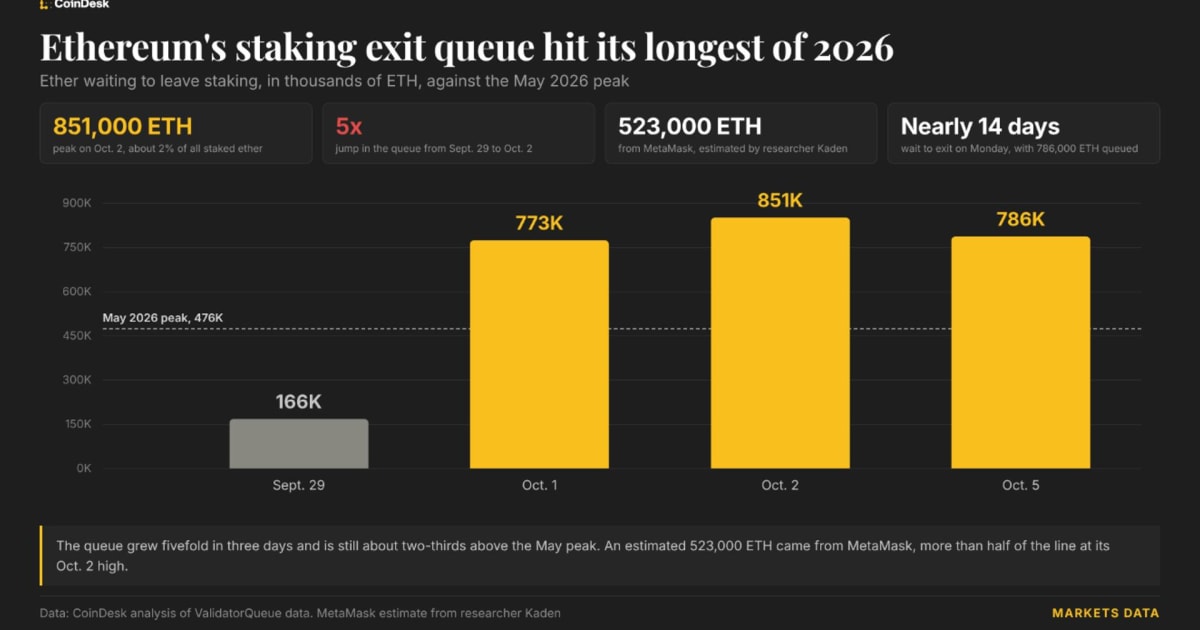
The digital asset landscape is experiencing a significant development as the Ethereum staking queue balloons, presenting an unprecedented wait time of approximately 25 days for new stakers to join the network. This substantial backlog, representing nearly 1.5 million ETH awaiting activation, is not merely a technical bottleneck; it's a powerful indicator of sustained and growing investor interest in the yield-generating capabilities of the Ethereum network post-its transformative Merge upgrade. For seasoned observers of financial markets, this surge in demand for staking rewards echoes the initial excitement seen during earlier phases of digital asset adoption, but now with a more mature, yield-focused investor base.
Why Does an Ethereum Staking Queue Matter for Global and Indian Investors?
The significance of this growing queue extends far beyond the immediate cryptocurrency ecosystem. It signifies a maturing market where investors, both retail and institutional, are actively seeking alternative income streams and are increasingly comfortable allocating capital to decentralized finance (DeFi) protocols. This sustained interest in DeFi yield opportunities can have a subtle yet discernible impact on global capital flows. When attractive yields are available in digital assets, particularly from a foundational blockchain like Ethereum, it can draw capital away from traditional asset classes. For Indian investors, who are increasingly participating in global financial markets and exploring diverse investment avenues, this trend is particularly relevant. Capital that might otherwise be deployed in domestic fixed-income instruments, gold, or even Indian equities could find its way into ETH staking, especially for those with a higher risk tolerance and a long-term outlook on blockchain technology.
Furthermore, the Ethereum staking queue is a barometer of institutional adoption and confidence in the security and profitability of Proof-of-Stake (PoS) consensus mechanisms. As more capital is locked into staking, it reduces the readily available supply of ETH on exchanges, potentially influencing its price dynamics. This, in turn, can affect the overall sentiment and investment thesis surrounding digital assets, which, while nascent in India, is gaining traction. The ability of a blockchain network to attract and retain capital through yield generation is a key determinant of its long-term viability and attractiveness, mirroring how established financial systems rely on interest rates and dividends to incentivize capital deployment.
Deep Market Impact Analysis: Connecting DeFi Yields to Indian Stock Performance
The connection between a booming Ethereum staking queue and the Indian stock market might appear indirect, but it operates through several crucial channels. Firstly, global capital allocation is a zero-sum game to a certain extent. When a significant portion of global investment capital, including that from Indian HNIs and sophisticated investors, is drawn to high-yield DeFi opportunities like ETH staking, it can lead to a relative slowdown in investment into other markets. This is particularly relevant for Indian equities, which have seen strong inflows in recent years. A sustained shift towards digital asset yields, especially if they consistently outperform traditional Indian fixed-income returns, could subtly dampen the incremental capital available for the Indian stock market.
Historically, periods of high interest in emerging asset classes have often coincided with shifts in traditional market sentiment. For instance, during the peak cryptocurrency bull runs of 2021, many speculative funds and retail investors diverted capital from traditional markets, leading to some volatility in sectors perceived as less growth-oriented. While the current Ethereum staking trend is more yield-driven and less speculative, the principle of capital reallocation remains. If ETH staking consistently offers an attractive Annual Percentage Yield (APY) – currently ranging from 3% to 4% for solo stakers and potentially higher through staking pools, net of fees – it competes directly with the yields offered by Indian public sector bank Fixed Deposits (FDs), which hover around 6-7%, or the dividend yields from stable Indian blue-chip stocks, often in the 1-2% range.
How Does Decentralized Finance Yield Affect Indian Equity Sectors?
The impact is not uniform across all sectors. The most discernible effect would be on companies that offer alternative investment products or financial services that compete with DeFi yields. For instance, **Indian banks** and **Non-Banking Financial Companies (NBFCs)** that rely on deposit mobilization and lending could see a gradual, albeit small, diversion of funds if a substantial number of Indian investors begin to view ETH staking as a viable alternative for passive income. While the market capitalization of crypto is still a fraction of traditional financial markets, its growth trajectory and the allure of high yields cannot be ignored by established financial institutions.
Consider the banking sector: The net interest margins (NIMs) for major Indian banks like **HDFC Bank (NSE: HDFCBANK)** and **ICICI Bank (NSE: ICICIBANK)** have been robust, typically in the 3.5% to 4.5% range. If a segment of their potential deposit base finds ETH staking more attractive, it could, over the long term, put subtle pressure on deposit growth or necessitate slightly higher deposit rates to remain competitive, impacting profitability. Similarly, asset management companies (AMCs) offering mutual funds, especially debt funds, might face increased competition from direct crypto yield opportunities, although the regulatory landscape and risk profiles are vastly different.
The **technology sector**, particularly companies involved in blockchain development or offering services to the crypto ecosystem, could be indirect beneficiaries. While direct listing of such entities on Indian exchanges is limited, global players in this space are undoubtedly watching the Ethereum staking trend as a validation of the PoS model and DeFi's potential. For Indian IT services companies that have a growing blockchain practice, such as **Infosys (NSE: INFY)** and **Tata Consultancy Services (NSE: TCS)**, an expanding and maturing DeFi market signifies increased demand for their expertise in developing, securing, and integrating blockchain solutions.
Stock-by-Stock Breakdown: Identifying Potential Winners and Losers in the Indian Market
While direct exposure to ETH staking is primarily through digital asset platforms, the ripple effects can be traced to specific Indian equities. It's crucial to reiterate that the impact is subtle and more about capital reallocation and sentiment rather than direct operational impact for most Indian companies.
- HDFC Bank (NSE: HDFCBANK): As India's largest private sector bank, HDFC Bank is a bellwether for the financial sector. A sustained global shift towards DeFi yields could lead to marginally slower deposit growth or increased competition for deposits, impacting its Net Interest Margins (NIMs) if it needs to raise deposit rates. While the immediate impact is negligible, a long-term trend of capital migration could be a concern. HDFC Bank's current P/E ratio hovers around 20-25, reflecting investor confidence in its stability and profitability, but a shift in deposit dynamics could be a factor to monitor.
- ICICI Bank (NSE: ICICIBANK): Similar to HDFC Bank, ICICI Bank, another major private lender, faces the indirect challenge of competing for capital. Its NIMs are typically in a comparable range. The bank's stock, trading at a P/E of approximately 18-22, is sensitive to interest rate cycles and deposit trends. A significant diversion of retail savings towards crypto yields could necessitate strategic adjustments in its deposit-gathering strategies.
- Infosys (NSE: INFY): This IT behemoth is a potential indirect beneficiary. As the DeFi ecosystem matures and demand for secure, scalable blockchain infrastructure grows, IT service providers like Infosys, with significant investments in blockchain and digital transformation services, could see increased project pipelines. Infosys's P/E ratio, typically in the 25-30 range, reflects its growth potential in emerging technologies. A thriving DeFi market validates the need for sophisticated technological solutions that Indian IT firms can provide.
- Tata Consultancy Services (NSE: TCS): As the largest Indian IT services exporter, TCS also stands to gain from the growth in blockchain and decentralized technologies. Their ability to develop and manage complex distributed ledger technologies for global clients positions them well to capitalize on the increasing demand for secure and efficient digital infrastructure. TCS, often trading at a premium P/E of 30-35, benefits from its reputation for innovation and execution in cutting-edge technologies.
- BSE Ltd. (NSE: BSE): While not directly involved in crypto staking, the Bombay Stock Exchange is a crucial player in the Indian capital markets. If the broader trend of digital asset adoption and innovation continues, it could spur demand for regulated digital asset trading platforms and related financial products within India. BSE, with its diverse revenue streams including trading, clearing, and data services, could potentially integrate or facilitate access to regulated digital asset markets in the future, though this is a longer-term prospect. Its current P/E ratio (which can be volatile due to its unique business model) reflects its position as a market infrastructure provider.
- Angel One Ltd. (NSE: ANGELONE): This retail-focused stock brokerage and wealth management platform is more directly exposed to shifts in investor behavior. If a significant portion of retail investors starts allocating funds to crypto, it could reduce the capital available for traditional equity trading or mutual fund investments through platforms like Angel One. Conversely, if Angel One were to offer regulated crypto services in the future, it could become a beneficiary. Its P/E ratio (often high, in the 40-60 range, reflecting its growth as a fintech disruptor) is sensitive to trading volumes and user acquisition.
It's important to note that the direct impact on these Indian stocks is currently low to neutral. The primary influence is through capital flows and sentiment. The winners in this Ethereum staking scenario are primarily global cryptocurrency exchanges and specialized staking service providers. Companies with substantial ETH holdings also benefit from increased network security and potential price appreciation driven by demand for staking. Traditional savings instruments and potentially other, less prominent altcoins could be considered indirect losers if capital becomes concentrated in ETH staking.
Expert Perspective: Bulls vs. Bears on DeFi Yields and Indian Markets
Bullish Argument: Bulls would argue that the Ethereum staking queue is a clear sign of maturity and growing utility in the DeFi space. This signals a long-term trend of capital moving into digital assets for yield, which is a positive for the entire blockchain ecosystem. For India, this could mean increased innovation in fintech and blockchain services, benefiting IT giants like TCS and Infosys. Furthermore, as India's own digital asset regulations evolve, companies like BSE and Angel One could become key players in a regulated Indian crypto market, turning this global trend into a domestic opportunity.
Bearish Argument: Bears might counter that the long staking queues are a sign of artificial scarcity or inefficient market mechanisms, potentially leading to frustration and selling pressure if investors need liquidity. They would emphasize the regulatory uncertainty surrounding staking rewards globally and the inherent volatility of cryptocurrencies. From an Indian market perspective, bears would highlight that any significant capital outflow from traditional Indian assets to crypto yields represents a risk to domestic market growth and could put pressure on Indian banks and financial institutions to raise deposit rates, impacting profitability.
Actionable Investor Playbook: Navigating the DeFi Yield Landscape
For the discerning Indian investor, the Ethereum staking queue presents a complex interplay of opportunity and risk. The key is to understand the indirect nature of the impact and to position accordingly.
- Watchlist: Keep a close eye on IT services companies like Infosys (NSE: INFY) and TCS (NSE: TCS). Any significant increase in their blockchain-related service revenues could be an early indicator of growing demand for DeFi infrastructure.
- Monitor: Track the deposit growth and Net Interest Margins (NIMs) of major Indian banks, particularly HDFC Bank (NSE: HDFCBANK) and ICICI Bank (NSE: ICICIBANK). A sustained slowdown in deposit growth or a need to increase deposit rates could signal the beginning of capital reallocation pressure.
- Consider (with caution): For investors with a high-risk tolerance and a deep understanding of digital assets, direct participation in ETH staking (via regulated platforms if available and compliant with Indian regulations) could be considered for its yield-generating potential. However, this should represent a small, speculative portion of a diversified portfolio.
- Long-Term Horizon: The trend towards DeFi yields is likely to persist as digital asset infrastructure matures. Investors seeking exposure to this trend through Indian equities should focus on companies that are either providing services to this ecosystem or are resilient to capital flow shifts.
- Entry Points: For IT stocks, consider dollar-cost averaging into positions during market dips, focusing on companies with strong fundamentals and a proven track record in emerging technologies.
The time horizon for observing significant impacts on Indian equities is likely medium to long-term (1-3 years), as capital reallocation trends take time to manifest. Short-term impacts will be primarily driven by broader market sentiment and macroeconomic factors.
Risk Matrix: Understanding the Potential Downsides
While the Ethereum staking queue signals positive demand, several risks warrant careful consideration:
- Liquidity Crunch Risk (Probability: Medium): The long wait times for unstaking ETH (which can also have a delay) could lead to frustration for stakers needing immediate liquidity. If market conditions turn adverse and many stakers simultaneously attempt to exit, it could create selling pressure on ETH and indirectly affect investor sentiment towards digital assets.
- Regulatory Uncertainty (Probability: High): The global regulatory landscape for cryptocurrency staking rewards remains fluid. Changes in tax laws or outright prohibitions in key jurisdictions could significantly impact the profitability and attractiveness of ETH staking, leading to capital flight. This is a persistent risk that investors must monitor closely.
- Smart Contract Vulnerability (Probability: Low): While Ethereum's PoS consensus is considered robust, the risk of smart contract exploits or network vulnerabilities, though low, is ever-present. A major security breach could erode investor confidence and lead to substantial losses, impacting the entire digital asset market.
- Competition from Other Yield Opportunities (Probability: Medium): As the DeFi space evolves, new staking opportunities or alternative yield-generating protocols could emerge, potentially diverting capital away from ETH staking if they offer superior risk-adjusted returns or more flexible liquidity options.
What to Watch Next: Upcoming Catalysts and Data Points
The narrative around Ethereum staking and its market implications will be shaped by several key developments:
- Ethereum Network Upgrades: Future upgrades to the Ethereum protocol (e.g., 'Danksharding' or further optimizations) could impact staking rewards, network efficiency, and overall demand.
- Regulatory Announcements: Watch for any new pronouncements from major regulatory bodies globally and within India regarding cryptocurrency staking, taxation of staking rewards, and digital asset frameworks.
- Institutional Adoption Data: Increased reporting of institutional inflows into ETH staking or dedicated crypto funds will provide further validation of the trend.
- DeFi Protocol Growth: The overall growth and innovation within the broader DeFi ecosystem, beyond just Ethereum staking, will indicate the sustained interest in decentralized finance.
- Macroeconomic Factors: Global interest rate policies and inflation trends will continue to influence where investors seek yield, indirectly affecting the attractiveness of both DeFi and traditional assets.
The Ethereum staking queue is more than a technical detail; it's a signal of a maturing digital asset market actively seeking yield. While its direct impact on Indian stocks is nascent, understanding these evolving capital flows is crucial for any investor navigating the complexities of the modern financial landscape.
Run a free AI Stock Screen
Our algorithmic screener scores any NSE/BSE stock on fundamentals, momentum, and risk — free to try, no card needed.
Try the AI Screener →Have questions about this story?
Ask Welth, our finance-focused AI research assistant, for a deeper breakdown — free trial included.
Chat with Welth AI →Disclaimer: This content is generated by WelthWest Research Desk based on publicly available reports and is for informational purposes only. It does not constitute financial advice, investment recommendations, or an offer to buy or sell securities. Always consult a qualified financial advisor before making investment decisions.