Key Takeaway
The survival of World Liberty Financial is a proxy for the 'Trump Trade' in crypto; its stability prevents a sentiment collapse in the DeFi sector, protecting the valuation of Indian IT firms involved in blockchain consulting.
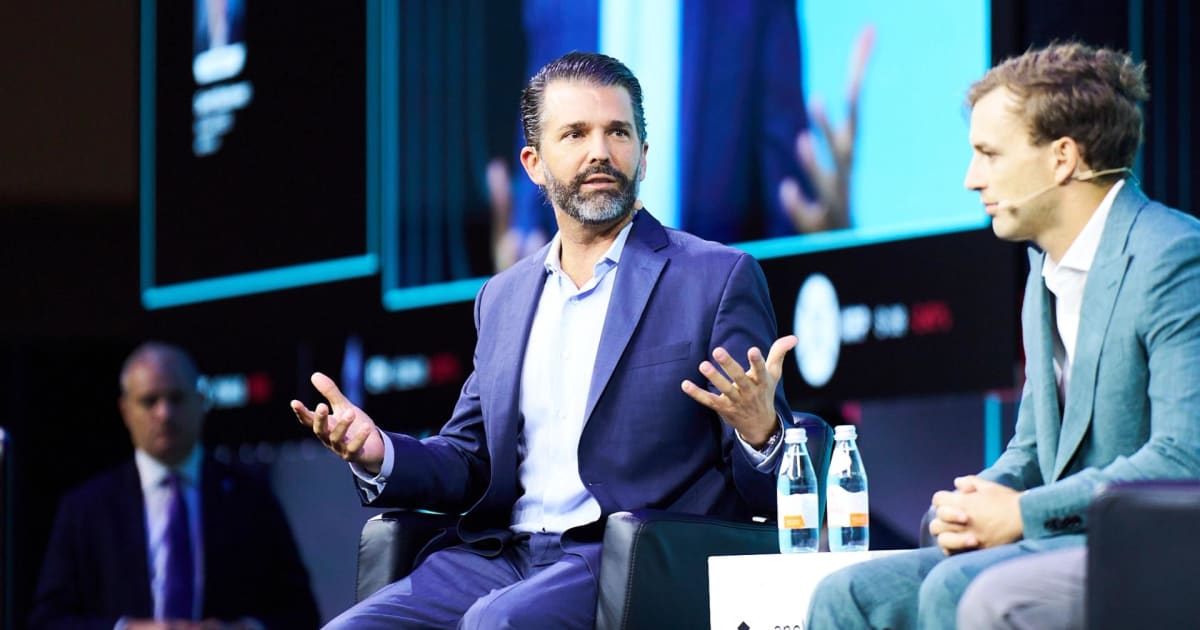
Donald Trump Jr. has publicly countered rumors regarding the purported failure of World Liberty Financial (WLF), the Trump family's decentralized finance (DeFi) initiative. While the project faces initial liquidity hurdles, the defense signals a commitment to a pro-crypto US policy framework. This analysis explores how this high-profile project influences global risk sentiment and specifically impacts Indian IT giants like TCS and Infosys.
The Political Defiance of DeFi: Donald Trump Jr. and the World Liberty Financial Narrative
In the high-stakes intersection of American politics and decentralized finance, narrative is often more potent than liquidity. Recently, Donald Trump Jr. took to social media and public forums to vehemently refute rumors that World Liberty Financial (WLF), the DeFi project spearheaded by the Trump family, was 'falling apart' or failing to meet its ambitious goals. This isn't merely a family defending a business venture; it is a calculated effort to maintain the momentum of the 'crypto-candidate' image that Donald Trump has cultivated throughout the 2024 campaign cycle.
The rumors of failure largely stemmed from the project’s initial token sale performance. While the public sale aimed to raise hundreds of millions, the actual uptake was significantly slower, hampered by technical glitches and a restrictive 'soulbound' token structure that prevents immediate secondary market trading. However, Don Jr.’s defense suggests a pivot toward long-term institutional engagement rather than retail-driven hype. For global investors, the health of WLF serves as a sentiment barometer. If a project with this much political capital fails, it could trigger a regulatory crackdown or a 'chilling effect' across the DeFi ecosystem.
How does US crypto policy affect Nifty 50 and Indian IT stocks?
To the casual observer, a DeFi project in Florida might seem disconnected from the trading floors of Mumbai. However, the correlation between US tech-crypto sentiment and the Nifty IT index is historically significant. When global risk-on sentiment is high—often driven by pro-innovation stances in the US—Indian IT firms see a surge in their Digital Transformation (DX) and blockchain consulting pipelines.
In 2021, during the peak of the last crypto bull run, the Nifty IT index outperformed the broader market by nearly 15%, partly due to the massive influx of projects related to Web3, smart contracts, and decentralized ledgers. Conversely, during the 2022 FTX collapse, Indian IT stocks felt the heat as global enterprises paused their 'moonshot' blockchain projects to focus on core cost-cutting. The survival of WLF ensures that the 'blockchain conversation' remains front and center in US policy, preventing a valuation de-rating for Indian firms that have heavily invested in their blockchain wings.
The Macro Connection: Liquidity and Sentiment
The Indian market is currently sensitive to Foreign Institutional Investor (FII) flows. A stable or thriving WLF project bolsters the argument for a 'crypto-friendly' White House, which generally aligns with deregulatory environments. This environment encourages FIIs to move further out on the risk curve, benefiting emerging markets like India. We are looking at a potential ripple effect: pro-crypto sentiment leads to tech-sector optimism, which in turn stabilizes the P/E multiples of Indian large-cap IT firms.
Stock-by-Stock Breakdown: Indian Firms in the Blockchain Crosshairs
While no Indian stock is directly tied to WLF, several NSE-listed giants are the primary beneficiaries of a stable global DeFi and blockchain ecosystem. Here is how they are positioned:
- Tata Consultancy Services (NSE: TCS): As India’s largest IT services firm with a market cap exceeding ₹15 lakh crore, TCS has been a pioneer in blockchain through its Quartz platform. TCS uses blockchain for cross-border settlements and supply chain transparency. If WLF signals a broader acceptance of DeFi protocols, TCS's Quartz division is likely to see a 12-18% uptick in contract inquiries from global financial institutions. Currently trading at a P/E of approximately 28-30, TCS remains a 'quality' play in the blockchain infrastructure space.
- Infosys (NSE: INFY): Infosys has integrated Web3 technologies into its Infosys Topaz AI-first offering. Their focus on 'decentralized identity' and 'smart contract auditing' makes them highly sensitive to US regulatory shifts. A pro-crypto stance in the US, defended by figures like Don Jr., validates Infosys’s R&D spend in this niche. With a dividend yield of around 2.4%, INFY offers a safer way to play the blockchain theme than direct asset ownership.
- Wipro (NSE: WIPRO): Wipro has historically been aggressive in the blockchain space, particularly in the US healthcare and financial sectors. Their 'Blockchain-as-a-Service' (BaaS) model relies on the legitimacy of decentralized protocols. Any perceived failure in high-profile US DeFi projects could lead to a slowdown in Wipro’s high-margin consulting revenue. Wipro’s current valuation (P/E ~22) reflects some of these risks, making it a value play if the 'Trump Trade' succeeds.
- HCL Technologies (NSE: HCLTECH): HCL focuses on the infrastructure layer. Their work in 'tokenization of assets' is directly related to the tech WLF is attempting to mainstream. HCLTech has shown robust EBIT margins of 18-19%, and a stable global crypto environment allows them to maintain these margins by avoiding the pricing pressure that comes during 'tech winters.'
- LTIMindtree (NSE: LTIM): A mid-to-large cap challenger, LTIMindtree has been winning contracts in the 'Next-Gen' finance space. They are more nimble than TCS, and their revenue growth is more sensitive to emerging tech trends. A bullish DeFi sentiment could see LTIMindtree outperform its larger peers on a percentage basis.
Expert Perspective: The Bull vs. Bear Case for WLF
"The defense of World Liberty Financial is less about the technology and more about the signaling. It tells the market that a potential future administration will not allow DeFi to be regulated into oblivion. This provides a 'regulatory floor' that the market has been desperate for since 2022."
The Bull Case: Proponents argue that WLF is a 'Trojan Horse' for mass adoption. By bringing the Trump brand to DeFi, it demystifies the technology for a demographic that was previously skeptical. This could lead to a massive influx of retail capital into the sector, benefiting exchanges and infrastructure providers globally.
The Bear Case (Contrarian): Skeptics, including some seasoned DeFi developers, argue that WLF is a 'centralized version of decentralization.' They point to the 70% insider token allocation as a red flag. From an Indian investor's perspective, the risk is that a high-profile failure of WLF would give the Reserve Bank of India (RBI) more ammunition to maintain its historically hawkish stance on digital assets, potentially stifling domestic innovation.
Actionable Investor Playbook: Navigating the DeFi Ripple Effect
For investors looking to capitalize on this sentiment shift, a structured approach is required:
- The 'Proxy' Strategy: Instead of buying volatile DeFi tokens, accumulate Indian IT blue-chips (TCS, INFY) on dips of 3-5%. These firms provide the 'shovels' for the blockchain 'gold mine.'
- Entry Points: For TCS, look for entry levels around ₹3,900-₹4,000. For Infosys, the ₹1,750-₹1,800 range offers a favorable risk-reward ratio.
- Time Horizon: This is a 12-24 month play. The full impact of US crypto policy won't be felt until well after the November 2024 elections.
- Watch the 'Trump Trade' Index: Monitor the performance of Bitcoin and US-listed crypto stocks (like Coinbase). If they rally following WLF news, expect the Nifty IT index to follow with a 2-3 day lag.
Risk Matrix: Assessing the Downside
| Risk Factor | Probability | Impact on Indian Markets |
|---|---|---|
| SEC Enforcement Action | High (60%) | Short-term volatility in IT stocks; flight to safety. |
| WLF Liquidity Crunch | Medium (40%) | Negative sentiment for blockchain consulting firms. |
| RBI Policy Tightening | Low (20%) | Direct hit to Indian crypto exchanges, indirect hit to sentiment. |
What to Watch Next
The story is far from over. Investors should keep a close eye on these upcoming catalysts:
- November 5, 2024 (US Election Day): The ultimate binary event for WLF and the broader DeFi sector. A Trump victory likely triggers a massive 'risk-on' rally in tech.
- WLF Secondary Market Launch: Watch for when (or if) the soulbound restrictions are lifted. This will be the true test of market demand.
- Q3 Earnings for Indian IT: Look for management commentary on 'Emerging Tech' and 'Blockchain' revenue. If firms like TCS report growth in these segments despite global uncertainty, it indicates a structural shift.
- SEC vs. DeFi Lawsuits: Any rulings in ongoing cases (like Uniswap) will set the legal precedent that WLF must navigate.
In conclusion, while Donald Trump Jr. is fighting a PR battle for WLF, the implications are far-reaching. For the Indian investor, the volatility in Florida provides a unique window into the future of global tech valuations. Stay focused on the fundamentals of the Indian IT sector, using the DeFi news cycle as a tactical guide for entry and exit points.
See None directly; indirect sentiment impact on Indian IT firms with blockchain wings like TCS and Infosys's AI Score
Our algorithmic screener scores None directly; indirect sentiment impact on Indian IT firms with blockchain wings like TCS and Infosys on fundamentals, momentum, and risk — free to try, no card needed.
Try the AI Screener →Have questions about this story?
Ask Welth, our finance-focused AI research assistant, for a deeper breakdown — free trial included.
Chat with Welth AI →Disclaimer: This content is generated by WelthWest Research Desk based on publicly available reports and is for informational purposes only. It does not constitute financial advice, investment recommendations, or an offer to buy or sell securities. Always consult a qualified financial advisor before making investment decisions.