Key Takeaway
The 'Higher-for-Longer' US rate regime is resetting global valuation models. Investors must pivot from high-duration growth assets toward cash-generative, low-debt entities as the cost of capital reaches a 17-year peak.
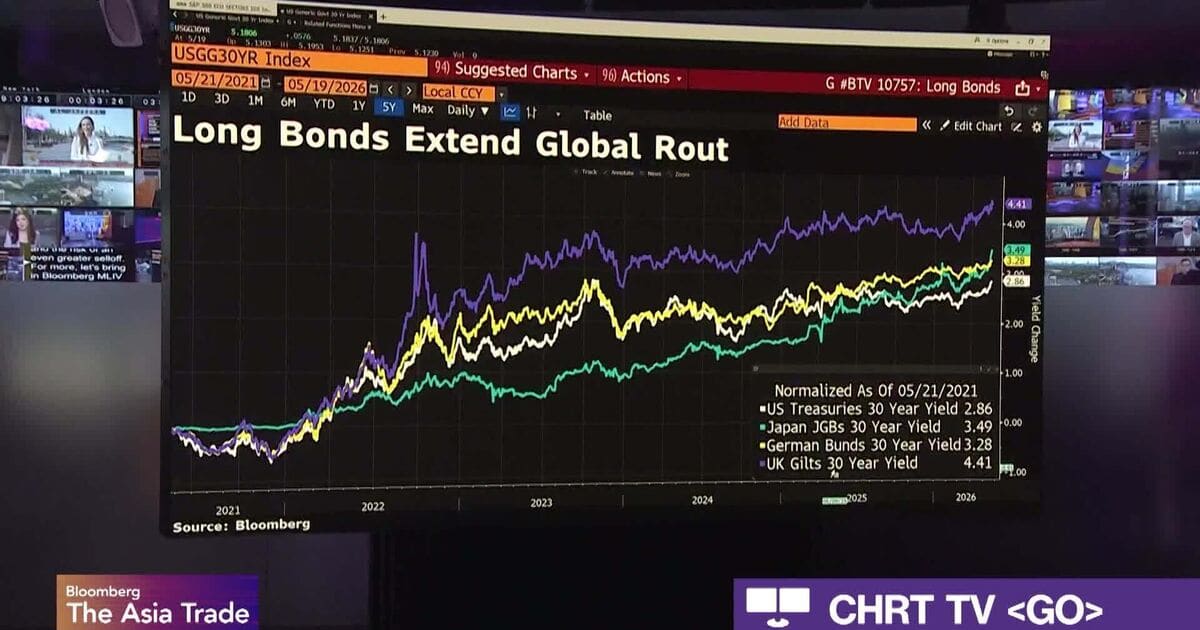
As US 30-year Treasury yields breach 2007 levels, the resulting dollar strength is triggering a structural shift in emerging market liquidity. This research note explores why the Nifty's high-growth sectors are facing a valuation crunch and how to navigate the current volatility.
The Great Yield Reset: Why 2007 Levels Matter Now
The global financial architecture is undergoing a seismic shift. As US 30-year Treasury yields pierce the psychological and technical barriers last seen during the onset of the 2007 Global Financial Crisis, the ripples are being felt acutely in the Indian equity markets. This is not merely a bond market oscillation; it is a fundamental recalibration of the 'risk-free' rate that dictates the discount factor for every asset class globally.
When the US long-end yield spikes, the opportunity cost of holding risk assets like Indian equities rises exponentially. For Foreign Institutional Investors (FIIs), the allure of a high-yielding, dollar-denominated safe haven—the US Treasury—drains liquidity from emerging markets. This creates a double-whammy for the Nifty: falling valuations due to higher discount rates and a depreciating Rupee, which further erodes the dollar-denominated returns for foreign allocators.
How will the US Treasury yield spike impact Indian bank stocks?
In the Indian context, the banking sector faces a nuanced reality. While rising yields globally usually correlate with a flatter yield curve, Indian banks—particularly those with strong CASA (Current Account Savings Account) ratios—are positioned differently. Historically, when interest rates rise, banks experience a lag in deposit repricing compared to asset repricing, which can lead to a short-term expansion in Net Interest Margins (NIMs). However, this is a race against credit quality.
If the 'higher-for-longer' environment persists, the cost of borrowing for corporate India will rise, potentially leading to a spike in Non-Performing Assets (NPAs). Banks like HDFC Bank (HDFCBANK), with its massive balance sheet, must balance NIM expansion against the risk of slowing loan growth. Investors should watch for the spread between the 10-year G-Sec and the US 10-year yield; when this gap narrows too far, capital flight from India becomes inevitable.
The Valuation Crunch: Which sectors are most vulnerable?
The Discounted Cash Flow (DCF) model is the silent killer in this environment. As the risk-free rate rises, the denominator in our valuation models grows, causing the 'fair value' of long-duration assets—specifically IT Services and High-Growth NBFCs—to contract. In 2022, when yields surged, the Nifty IT index corrected by over 20% as investors rotated out of growth and into value.
Sector-Level Breakdown:
- IT Services (TCS, INFY, HCLTECH): These companies are highly sensitive to the US economic climate. A high-yield environment suggests a slowing US economy, which translates into lower IT spending and budget cuts for digital transformation projects.
- NBFCs (Bajaj Finance): With a high dependence on debt markets for funding, rising yields directly squeeze margins. Bajaj Finance (BAJFINANCE), while a market leader, faces a P/E compression risk if funding costs rise faster than they can pass on to retail consumers.
- Real Estate (DLF): As a highly leveraged sector, real estate demand is inversely correlated with mortgage rates. DLF faces a double risk: higher cost of debt for construction and a potential cooling in urban housing demand.
Stock-by-Stock Analysis: Navigating the Bearish Sentiment
HDFC Bank (HDFCBANK): Currently trading at a P/E that reflects long-term compounding, the bank is a 'watch' rather than a 'buy.' If NIMs hold above 3.5%, the stock remains a defensive anchor, but the current yield environment limits its upside.
TCS (TCS) & Infosys (INFY): These are classic growth-duration stocks. Their valuations are predicated on long-term earnings growth. With the discount rate rising, their P/E multiples are likely to stay compressed. Investors should look for entry points only when US yield volatility stabilizes.
Bajaj Finance (BAJFINANCE): The stock is a proxy for consumer credit. With funding costs rising, expect a margin contraction in the next two quarters. We maintain a cautious stance until the company demonstrates pricing power in its loan book.
DLF (DLF): High beta and high debt make this a 'sell' or 'underweight' in a rising-yield cycle. The cost of carrying land banks will weigh heavily on the balance sheet.
The Contrarian View: Bulls vs. Bears
The Bear Case: The 'higher-for-longer' narrative is a structural threat. Persistent inflation in the US will force the Fed to keep rates elevated, causing a systematic re-rating of Indian equities from a 25x P/E to a 20x P/E, wiping out trillions in market cap.
The Bull Case: India’s domestic consumption story is decoupling from US macro. With strong GST collections and corporate earnings growth, the 'India Alpha' will eventually override the global 'Beta' of US Treasury yields. Bulls argue that this correction is a healthy cleansing of froth, providing an entry point into high-quality compounders at a discount.
Actionable Investor Playbook
- Reduce Beta: Trim exposure to high-debt, high-growth, and interest-rate-sensitive stocks.
- Shift to Cash-Generative Value: Focus on companies with low debt-to-equity ratios and strong free cash flow (FCF).
- Currency Hedging: Consider exporters with natural USD hedges, but be wary of companies with high USD-denominated debt.
- Time Horizon: Shift to a 3-5 year horizon. Short-term trading in this environment is akin to catching a falling knife.
Risk Matrix
| Risk Factor | Probability | Impact |
|---|---|---|
| US Recession | Moderate | High |
| Sustained USD/INR Depreciation | High | Moderate |
| FII Liquidity Withdrawal | High | High |
What to Watch Next
Keep a close eye on the US CPI prints and the Federal Reserve’s dot plot projections. Any signal of a pivot will be the primary catalyst for a reversal in this bearish trend. Locally, monitor the RBI’s MPC meeting minutes; if the RBI begins to diverge from the Fed, the Rupee volatility will become the single most important metric for Nifty performance.
See TCS's AI Score
Our algorithmic screener scores TCS on fundamentals, momentum, and risk — free to try, no card needed.
Try the AI Screener →Have questions about this story?
Ask Welth, our finance-focused AI research assistant, for a deeper breakdown — free trial included.
Chat with Welth AI →Disclaimer: This content is generated by WelthWest Research Desk based on publicly available reports and is for informational purposes only. It does not constitute financial advice, investment recommendations, or an offer to buy or sell securities. Always consult a qualified financial advisor before making investment decisions.
