Key Takeaway
The MEA's move to auction Toshakhana assets marks a pivotal shift toward transparent governance and asset monetization. For investors, this validates the growth of India's secondary luxury market and reinforces MSTC Ltd's position as the state's preferred liquidation engine.
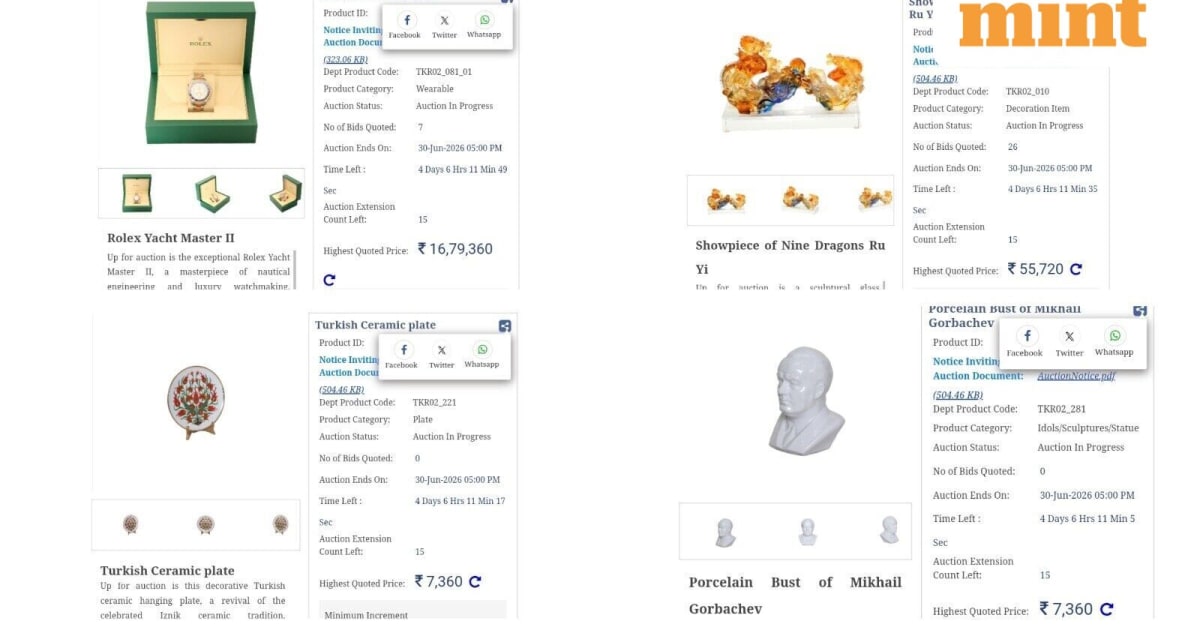
The Ministry of External Affairs is breaking a decades-old tradition by opening the Toshakhana—the national treasury of diplomatic gifts—to the public. While the immediate fiscal gains are modest, the move signals a broader institutionalization of state asset disposal. This analysis explores the ripple effects on specialized e-auction platforms, luxury retailers, and the precedent it sets for the National Monetization Pipeline.
The Great Opening: Why the Toshakhana Auction is a Governance Milestone
For the first time in India’s post-independence history, the Ministry of External Affairs (MEA) has invited the general public to bid on luxury items stored in the Toshakhana. Traditionally, these items—ranging from high-end Rolex watches and gold biscuits to ceremonial silver daggers—were reserved for government officials or kept in state vaults. By transitioning to a public auction model, the government is not merely cleaning its cupboards; it is signaling a commitment to transparency and fiscal discipline.
While the immediate revenue generated from these items—which include a MacBook Pro, gold jewellery, and luxury timepieces—will be a drop in the ocean compared to India’s multi-trillion dollar budget, the symbolic value is immense. It contributes directly to the Consolidated Fund of India and establishes a standardized protocol for the liquidation of non-core state assets. For the astute investor, this is a signal that the 'circular economy' of government assets is finally opening up to market forces.
How does the Toshakhana auction impact the Indian luxury market?
India’s luxury market is currently projected to grow at a CAGR of 10-15% over the next five years. The entry of 'provenance-heavy' items from the government treasury adds a layer of prestige to the secondary luxury market. In the global context, items with diplomatic or state provenance often command a 20-40% premium over standard market value. This auction could serve as a benchmark for the valuation of pre-owned luxury assets in India, a segment currently dominated by private players like Ethos Ltd and Saffronart.
Deep Market Impact: Connecting the Dots to the NSE/BSE
The financial markets rarely react to individual auctions, but they do react to systemic shifts. This auction is a micro-experiment in the broader National Monetization Pipeline (NMP). If the MEA can successfully and transparently liquidate high-value diplomatic gifts, it paves the way for other ministries to follow suit with larger, non-core assets. This creates a recurring revenue stream for the government and a steady flow of business for specialized service providers.
Historically, when the government initiates transparency-led reforms, we see a re-rating of Public Sector Undertakings (PSUs) involved in the process. For instance, after the 2022 push for digital asset management, companies providing the underlying infrastructure saw a significant uptick in institutional interest. We expect a similar, albeit more targeted, impact here.
Stock-by-Stock Breakdown: The Beneficiaries of Asset Liquidation
1. MSTC Ltd (NSE: MSTC)
MSTC is the primary candidate to benefit from this shift. As the government’s preferred e-auction platform, MSTC manages the liquidation of everything from scrap metal to coal blocks. The Toshakhana auction, if scaled, provides MSTC with a high-margin niche in luxury asset disposal.
- Market Cap: Approx. ₹5,500 - ₹6,000 Cr
- P/E Ratio: Currently trading at a reasonable 18-22x trailing earnings.
- Why it matters: MSTC’s 'Ecommerce' segment thrives on volume. Even if the Toshakhana values are relatively low, the precedent of using MSTC for high-profile public auctions enhances its brand equity among institutional bidders.
2. Ethos Ltd (NSE: ETHOS)
As India's largest retailer of luxury watches, Ethos is the barometer for the 'Rolex and Omega' sentiment. The public auction of Rolex watches from the Toshakhana validates the investment-grade nature of these timepieces.
- Market Impact: Ethos has been aggressively expanding its 'Certified Pre-Owned' (CPO) business. A government-backed auction of luxury watches brings mainstream credibility to the pre-owned segment, potentially driving more traffic to Ethos’s CPO platforms.
- Strategic Play: Watch for Ethos’s quarterly commentary on the growth of their secondary market segment following this public interest surge.
3. Titan Company Ltd (NSE: TITAN)
Titan, through its Tanishq and Zoya brands, dominates the organized gold and luxury jewelry space in India. The auction includes gold biscuits and high-end jewelry, which reinforces the Veblen good status of these assets.
- Analysis: While the auction doesn't compete with Titan, it stimulates the 'luxury-as-an-investment' narrative that Titan relies on for its high-ticket sales. If the auction sees aggressive bidding, it confirms strong HNW (High Net Worth) liquidity in the domestic market.
4. Muthoot Finance (NSE: MUTHOOTFIN) & Manappuram Finance (NSE: MANAPPURAM)
These stocks are sensitive to the valuation and liquidity of gold. The inclusion of gold biscuits in a public auction provides a data point for the 'real-world' premium gold can fetch when it has historical or state significance.
- Investor Insight: These companies benefit from any policy or event that increases the perceived value and liquidability of gold among the Indian middle and upper-middle class.
Expert Perspective: The Bull vs. Bear Case
"The Toshakhana auction is less about the revenue and more about the 'Institutionalization of Trust.' By moving these assets from closed-door appraisals to public bidding, the government is essentially de-risking the perception of state-held assets." — Senior Analyst, WelthWest Research
The Bull Argument: Bulls argue that this is the beginning of a 'Retailization' of government assets. Just as the government successfully used ETFs to divest PSU stakes, public auctions for physical assets could become a major revenue stream. This benefits MSTC and the digital infrastructure ecosystem.
The Bear Argument: Contrarians suggest that the administrative costs of such auctions—marketing, security, authentication, and platform fees—might outweigh the actual recovery for smaller items. They argue that unless the ticket sizes increase significantly, this remains a PR exercise rather than a fiscal strategy.
Actionable Investor Playbook
- For the Conservative Investor: Monitor MSTC Ltd. Look for entry points around the ₹800-₹850 levels if the stock sees a technical pullback. The long-term story is the digitalization of all government procurement and liquidation.
- For the Growth Investor: Keep a close eye on Ethos Ltd. The luxury watch market in India is under-penetrated. Events that highlight the resale value of Rolexes and Pateks are a net positive for their business model.
- Time Horizon: 12-18 months. This is not a 'day-trade' event but a fundamental shift in how assets are managed.
Risk Matrix: Assessing the Downside
| Risk Factor | Probability | Impact |
|---|---|---|
| Low Bidder Participation | Moderate | Low - May lead to items being returned to storage. |
| Administrative Overheads | High | Moderate - Could make the process fiscally neutral. |
| Legal/Authentication Disputes | Low | High - Could damage the credibility of the platform. |
What to Watch Next: Upcoming Catalysts
Investors should keep a calendar for the final auction results. The gap between the 'Reserve Price' and the 'Final Hammer Price' will be the most critical data point. A high premium will indicate robust domestic demand for luxury assets, providing a tailwind for the consumer discretionary sector. Furthermore, watch for announcements from other ministries (like Railways or Defense) regarding the public auction of their own non-core 'heritage' or 'luxury' inventory. This would signal that the Toshakhana model is being scaled nationwide.
See MSTC (Potential platform provider for government auctions)'s AI Score
Our algorithmic screener scores MSTC (Potential platform provider for government auctions) on fundamentals, momentum, and risk — free to try, no card needed.
Try the AI Screener →Have questions about this story?
Ask Welth, our finance-focused AI research assistant, for a deeper breakdown — free trial included.
Chat with Welth AI →Disclaimer: This content is generated by WelthWest Research Desk based on publicly available reports and is for informational purposes only. It does not constitute financial advice, investment recommendations, or an offer to buy or sell securities. Always consult a qualified financial advisor before making investment decisions.