Key Takeaway
The recent XRP price drop and broader crypto market instability, exacerbated by the Clarity Act's failure, signals a global flight from speculative assets. While direct Indian institutional exposure is minimal, this shift could indirectly dampen sentiment for high-growth tech stocks and potentially re-route FII capital towards safer traditional Indian equities.
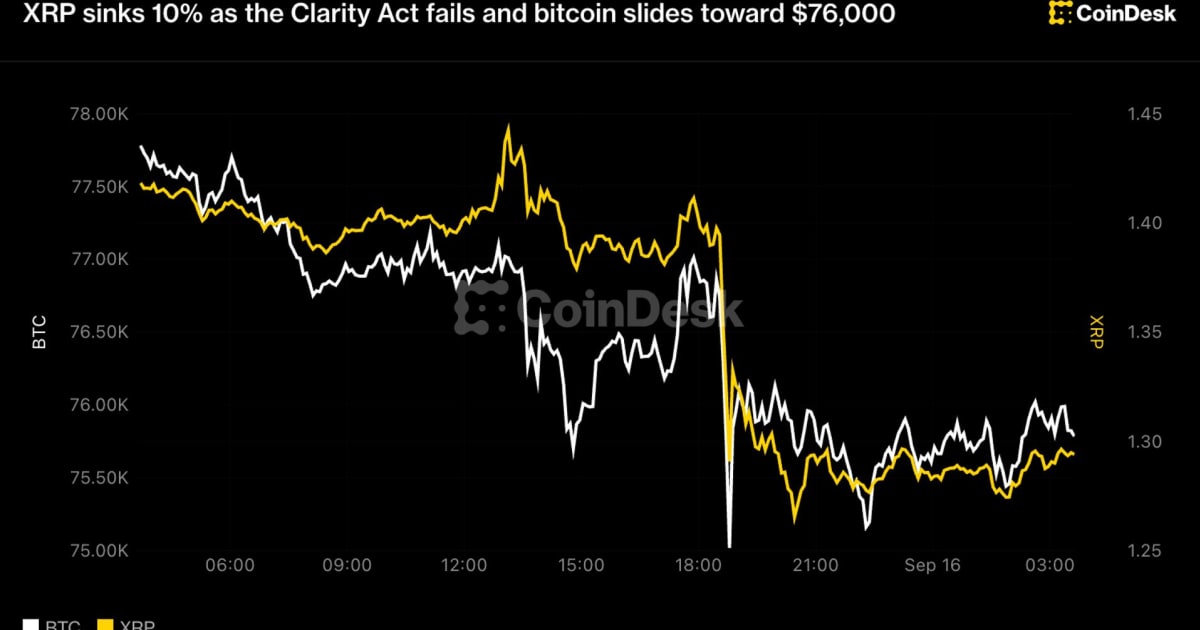
The cryptocurrency market, led by XRP's significant price decline and Bitcoin's slide, is experiencing a notable downturn. This event, coupled with the failure of the Clarity Act, points to heightened risk aversion in digital assets globally. Our in-depth analysis explores the indirect implications for the Indian stock market, particularly within the technology and innovation-driven sectors, offering an investor's playbook for navigating this evolving landscape.
XRP Plunge & Clarity Act Failure: Unpacking the Indirect Ripple on Indian Equities
The digital asset landscape is currently navigating turbulent waters, marked by a significant price decline in XRP and a broader correction across the cryptocurrency market, including Bitcoin's slide. This downturn, amplified by the legislative setback of the Clarity Act, is not merely a contained event within the crypto sphere; it sends ripples across global financial markets, with nuanced, albeit indirect, implications for Indian equities. At WelthWest Research Desk, we dissect this complex interplay, providing an original, data-driven perspective on how heightened risk aversion in digital assets could influence India's investment climate.
The core event — XRP's 10% dip following the Clarity Act's failure and Bitcoin's approach towards the $76,000 mark — serves as a potent indicator of shifting investor sentiment. The Clarity Act, intended to provide regulatory certainty for digital assets, particularly XRP, was seen as a potential catalyst for broader institutional adoption. Its failure underscores the persistent regulatory ambiguity plaguing the crypto sector, a factor that consistently spooks risk-averse capital. This development, occurring amidst a wider crypto market slide, amplifies the narrative of a global retreat from speculative, high-volatility assets.
From an Indian perspective, while direct institutional exposure to cryptocurrencies remains limited due to stringent regulatory stances, the indirect impact is multifaceted. A sustained downturn in global crypto markets can breed a broader risk-off sentiment, influencing foreign institutional investor (FII) flows into emerging markets like India. Furthermore, the psychological effect on investors, particularly those with a higher appetite for growth and innovation, could lead to a re-evaluation of high-beta tech stocks within the Indian market. This analysis will delve into these intricate connections, offering actionable insights for savvy investors.
How Does Crypto Market Volatility Impact Indian Tech Stocks?
The immediate connection between a cryptocurrency like XRP and the Indian stock market might seem tenuous, yet the underlying sentiment shifts are profoundly interconnected. The crypto market, often viewed as a bellwwether for global risk appetite, especially for innovative and disruptive technologies, can influence investor confidence in other high-growth sectors. When digital assets experience significant corrections, it often reflects a broader flight to safety, where capital migrates from speculative ventures to more established, less volatile asset classes.
For India, this translates into potential headwinds for the technology sector. While Indian IT services companies primarily cater to global enterprises, their valuations often reflect investor enthusiasm for growth stories and future-proof business models. A global risk-off environment, triggered by crypto instability, can lead to a re-rating of these growth stocks. Historically, during periods of heightened global uncertainty, such as the Dot-Com Bubble bursting in 2000 or the 2008 financial crisis, capital typically flowed out of high-beta tech stocks into more defensive sectors like FMCG or pharmaceuticals. More recently, the crypto winter of 2022 coincided with a period of moderate underperformance for the Nifty IT index, which saw a decline of approximately 25% from its peak, even as the broader Nifty 50 demonstrated resilience.
FIIs, who play a crucial role in driving Indian market dynamics, are particularly sensitive to global risk signals. A prolonged crypto downturn could lead to a reduction in their overall exposure to emerging market equities, or a reallocation within their Indian portfolios, favoring established blue-chip companies over nascent, high-growth tech ventures. This shift in FII behavior could manifest as increased selling pressure on segments of the Indian tech sector that are perceived as more speculative or whose valuations have run ahead of fundamentals. For instance, companies involved in nascent digital transformation, AI, or blockchain-adjacent services, even if not directly involved in crypto, could face scrutiny.
Furthermore, the sentiment contagion can extend to venture capital and private equity funding for Indian startups, particularly those in the fintech and Web3 space. A cooling in global crypto enthusiasm might lead to tighter funding conditions, indirectly impacting the pipeline of future IPOs and growth stories that typically excite public market investors. This creates a challenging environment for valuations, especially for companies with high P/E ratios justified by aggressive growth projections.
Which Indian Stocks Are Most Vulnerable to Crypto Market Sentiment?
While no Indian company has direct, material exposure to XRP or other cryptocurrencies on its balance sheet, several NSE/BSE listed entities could experience indirect impacts from a sustained crypto downturn and global risk aversion. Identifying these stocks requires looking beyond direct crypto involvement to sectors that thrive on investor appetite for growth, innovation, and global capital flows.
- Infosys (NSE: INFY): As a leading Indian IT services giant with a market capitalization exceeding INR 6.5 trillion and a P/E ratio around 25x, Infosys is highly sensitive to global economic sentiment. While its core business is robust, a global flight from risk can lead to reduced IT spending from its international clients, particularly in discretionary digital transformation projects. Furthermore, its valuation, while reasonable for its scale, can compress if FIIs de-risk from growth-oriented IT. Peer: Tata Consultancy Services (NSE: TCS), which, despite its defensive qualities, also faces similar sentiment-driven headwinds in a prolonged risk-off environment.
- Persistent Systems (NSE: PERSISTENT): A mid-cap IT services company focused on digital engineering and product development, Persistent Systems (market cap ~INR 600 billion, P/E ~45x) is an example of a stock whose higher valuation reflects strong growth potential and a focus on cutting-edge technologies. In a risk-off scenario, investors might question these growth premiums, leading to potential P/E contraction. Companies like Persistent, which are at the forefront of innovation, often see their valuations disproportionately affected by shifts in speculative capital.
- Zomato (NSE: ZOMATO): As a prominent Indian tech-driven platform company (market cap ~INR 1.6 trillion, currently unprofitable but with strong revenue growth), Zomato's valuation is heavily reliant on future growth expectations and investor confidence in the broader tech ecosystem. A global risk aversion fueled by crypto instability can make investors more discerning about profitability and cash flow generation, potentially putting pressure on stocks with high growth, but lower current profitability metrics. Peer: Nykaa (NSE: NYKAA), another new-age tech platform whose valuation is driven by market share gains and future potential.
- Happiest Minds Technologies (NSE: HAPPSTMNDS): This digital transformation and IT consulting firm (market cap ~INR 130 billion, P/E ~50x) epitomizes the high-growth, high-valuation segment of the Indian IT sector. Its focus on disruptive technologies makes it attractive during periods of high risk appetite. However, in a risk-off environment, these very characteristics can make it vulnerable to sharper corrections as investors rotate into more value-oriented or defensive plays.
- Route Mobile (NSE: ROUTE): A cloud communication platform provider (market cap ~INR 100 billion, P/E ~35x), Route Mobile represents a segment of tech companies that enable digital infrastructure. While its services are fundamental, its growth trajectory and valuation are still tied to the broader digital adoption narrative. A slowdown in global tech spending or a general investor pullback from growth stocks can impact its multiples.
Expert Perspectives: Bulls vs. Bears on Indian Tech's Resilience
The current crypto market turbulence elicits varied interpretations from market strategists regarding its implications for Indian equities. The 'bears' would argue that the failure of the Clarity Act and the broader crypto slide are stark reminders of the inherent volatility and regulatory risks associated with speculative assets. They contend that this will inevitably lead to a broader investor recalibration, where capital moves away from growth-oriented tech stocks globally, including India, towards traditional safe havens. This perspective highlights the potential for FII outflows from Indian equities, particularly those in the high-beta tech sector, as global portfolios de-risk. They might point to the fact that Indian tech stocks, despite their strong fundamentals, often trade at a premium, making them susceptible to P/E contraction during periods of global uncertainty. The argument is that what starts as a crypto correction can quickly become a 'risk-off' contagion affecting all assets perceived as growth-dependent or speculative.
Conversely, the 'bulls' offer a more sanguine outlook. They emphasize that the Indian market, particularly its robust IT services sector, is fundamentally distinct from the highly speculative crypto market. They would argue that Indian IT companies derive their revenue from essential global enterprise spending on digital transformation, which is a structural, long-term trend, rather than speculative capital. The direct exposure of Indian financial institutions and corporates to crypto is negligible, insulating the core economy. Furthermore, India's strong domestic consumption story, robust macro fundamentals (e.g., projected GDP growth, moderating inflation), and recent policy reforms provide a strong buffer against global headwinds. Bulls might suggest that any FII outflow from tech stocks would likely be temporary, or even present an opportunity for domestic investors to accumulate quality assets at more attractive valuations. They could also argue that India's growing digital economy and tech startup ecosystem are driven by fundamental demand and innovation, not merely speculative fervor, making them resilient to external shocks from niche markets like crypto.
Actionable Investor Playbook: Navigating the Crypto Contagion
For Indian investors, the current environment demands a nuanced approach, blending caution with opportunistic thinking. This isn't a time for panic, but rather for strategic portfolio adjustments and a keen eye on evolving market dynamics.
What to Buy:
- Quality Large-Cap IT: While some sentiment pressure might exist, established players like Infosys (NSE: INFY) and TCS (NSE: TCS) with strong balance sheets, diversified client bases, and consistent dividend payouts, offer relative safety. Look for dips as potential entry points, focusing on long-term accumulation. Their valuations, though not cheap, are more defensible than smaller, high-growth tech companies in a risk-off climate.
- Defensive Sectors: Consider increasing allocation to sectors traditionally resilient during downturns. FMCG (e.g., Hindustan Unilever - NSE: HUL) and Pharmaceuticals (e.g., Sun Pharmaceutical Industries - NSE: SUNPHARMA) offer stable demand and often act as flight-to-safety assets.
- Value-Oriented Financials: Strong private sector banks with robust asset quality and prudent lending practices, like HDFC Bank (NSE: HDFCBANK) or ICICI Bank (NSE: ICICIBANK), could benefit from a rotation into traditional value plays, especially if interest rates stabilize.
What to Sell/Reduce:
- High-Valuation, Unprofitable Tech: Re-evaluate exposure to Indian tech stocks with very high P/E ratios (e.g., >60x) or those still in their early growth phases with no clear path to profitability. Companies like Zomato (NSE: ZOMATO) or other recent tech IPOs whose valuations are almost entirely based on future potential might face significant pressure from discerning investors. Consider trimming positions if they constitute a disproportionately large part of your portfolio.
- Small-Cap/Micro-Cap Tech with Weak Fundamentals: These companies are often the first to feel the pinch of reduced risk appetite. If a small-cap tech stock lacks a clear competitive advantage, strong cash flows, or a diversified revenue stream, it might be prudent to reduce exposure.
What to Watch:
- FII Flow Data: Monitor daily FII investment data from the NSDL website. Sustained net outflows from Indian equities, particularly from the IT sector, would signal increasing risk aversion. Conversely, a return to net buying would indicate stabilizing sentiment.
- Global Macro Indicators: Keep an eye on global inflation data, central bank policy statements (especially the US Fed), and geopolitical developments. These factors significantly influence global risk appetite and FII behavior.
- Regulatory Developments in Crypto: While the Clarity Act failed, other jurisdictions are actively pursuing crypto regulation. Any clear, positive regulatory framework from major economies could help stabilize crypto markets and, by extension, global risk sentiment.
Time Horizon: For long-term investors (3-5+ years), quality Indian tech companies still represent compelling growth stories, and any dips could be accumulation opportunities. Short-to-medium term traders (3-12 months) should be more cautious, focusing on momentum shifts and sector rotation.
Risk Matrix: Assessing Potential Headwinds
Understanding the potential risks is crucial for prudent portfolio management:
- Continued Regulatory Uncertainty (Probability: High): The failure of the Clarity Act underscores the persistent lack of clear regulatory frameworks for digital assets globally. This uncertainty can continue to weigh on crypto markets and broader risk sentiment. A new wave of regulatory crackdowns or further legislative delays could prolong the crypto downturn, indirectly affecting FII appetite for growth assets in India.
- Broader Crypto Market Downturn (Probability: Medium-High): If Bitcoin continues its slide towards lower support levels, potentially breaking below $70,000, and altcoins like XRP face sustained selling pressure, it could signal a deeper 'crypto winter.' This would reinforce the global risk-off narrative, leading to more pronounced FII outflows from emerging market equities, including Indian tech.
- Spillover into Other Speculative Assets (Probability: Medium): A prolonged crypto correction might not remain isolated. It could trigger a broader re-evaluation of other speculative asset classes globally, such as high-growth tech stocks, venture capital investments, and even certain commodities. This 'contagion effect' could lead to a more significant correction in segments of the Indian market that are perceived as having stretched valuations.
- Global Economic Slowdown (Probability: Medium): While not directly caused by crypto, a crypto downturn coinciding with a global economic slowdown (e.g., due to persistent inflation, higher interest rates, or geopolitical conflicts) would create a 'perfect storm' for risk assets. This would severely impact corporate earnings for Indian IT firms and dampen overall investor sentiment, leading to significant market corrections.
What to Watch Next: Catalysts and Data Points
The coming weeks and months will be crucial in determining the trajectory of both crypto markets and their indirect impact on Indian equities. Investors should closely monitor the following:
- US CPI Data (Upcoming Release Dates): Inflation figures from the US will heavily influence the Federal Reserve's monetary policy decisions. Higher-than-expected inflation could lead to continued hawkishness, dampening risk appetite globally and potentially extending the crypto downturn. Conversely, cooling inflation could provide some relief.
- Major Central Bank Meetings (e.g., US Fed, ECB): The outcomes of these meetings, particularly statements regarding interest rates and quantitative tightening, will directly impact global liquidity and investor willingness to take on risk. Any dovish pivot could be a positive catalyst for risk assets, including tech stocks.
- New Crypto Regulatory Frameworks: While the Clarity Act failed, watch for progress on crypto legislation in other major economies (e.g., EU's MiCA, UK's regulatory proposals). Clear, positive regulatory developments could instill confidence in the crypto market, potentially stabilizing prices and improving broader risk sentiment.
- Q1/Q2 Earnings Season for Indian IT: The upcoming earnings reports from major Indian IT service providers will offer insights into client spending patterns, deal wins, and management outlooks. Any signs of significant slowdowns or cautious guidance could reinforce negative sentiment towards the sector, irrespective of crypto market movements. Conversely, strong results could provide a much-needed boost.
- FII Investment Trends in India: Continuous monitoring of FII net flows will be a key indicator of foreign investor confidence in the Indian market, especially in growth-oriented sectors.
The XRP price drop and the broader crypto market slide, while seemingly distant, are important barometers of global risk sentiment. For the discerning Indian investor, understanding these indirect connections and preparing a resilient portfolio is paramount to navigating the evolving financial landscape.
Run a free AI Stock Screen
Our algorithmic screener scores any NSE/BSE stock on fundamentals, momentum, and risk — free to try, no card needed.
Try the AI Screener →Have questions about this story?
Ask Welth, our finance-focused AI research assistant, for a deeper breakdown — free trial included.
Chat with Welth AI →Disclaimer: This content is generated by WelthWest Research Desk based on publicly available reports and is for informational purposes only. It does not constitute financial advice, investment recommendations, or an offer to buy or sell securities. Always consult a qualified financial advisor before making investment decisions.