Key Takeaway
A surprisingly weak US September 2026 jobs report significantly elevates the probability of an earlier Federal Reserve rate pause or cut, creating a compelling bullish catalyst for Indian IT services and broad equity markets due to anticipated FII inflows and a stronger Rupee.
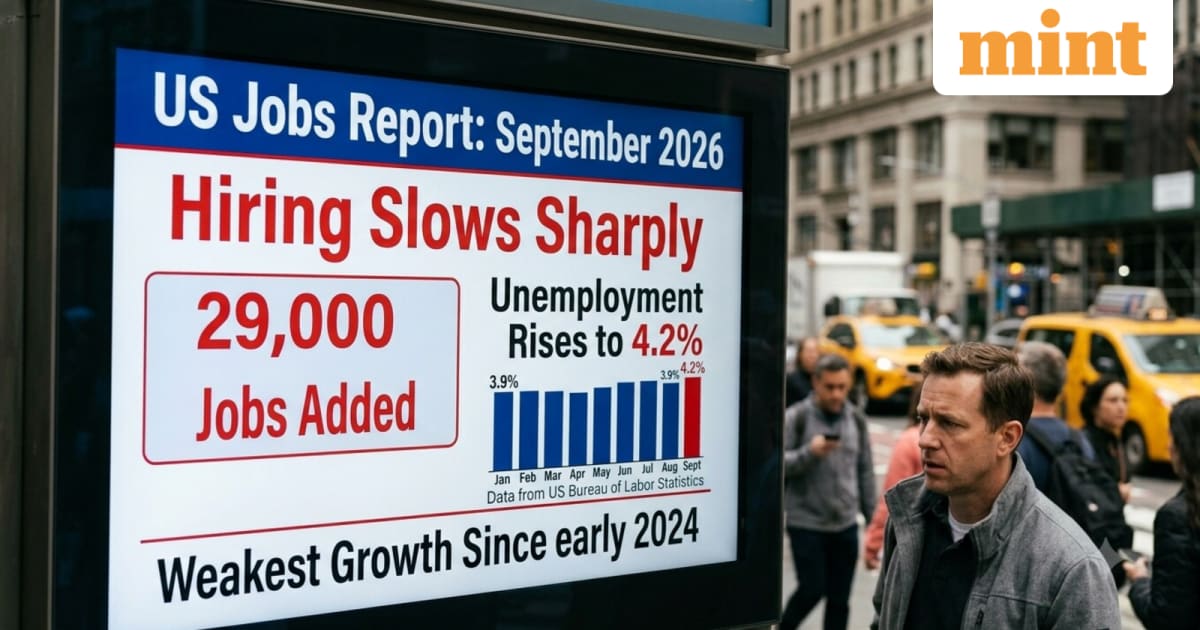
The US labor market just delivered a shock, with September 2026 job creation plummeting and unemployment ticking up. This pivotal shift in the world's largest economy is poised to reverberate across global financial markets, with particularly profound implications for India. WelthWest Research dissects how a dovish Fed pivot could ignite FII flows, strengthen the Rupee, and reshape the investment landscape for Indian IT and rate-sensitive sectors.
US Jobs Market Stumbles: A Definitive Shift for Global Capital Flows
The latest US jobs report for September 2026 has sent a clear, undeniable signal: the American labor market is cooling faster than anticipated. With a mere 29,000 non-farm payroll additions, significantly below consensus estimates, and the unemployment rate edging up to 4.2%, the narrative of a 'resilient' US economy is now under serious scrutiny. This is not merely a statistical blip; it represents a critical inflection point for global monetary policy and capital allocation, with profound implications for emerging markets, particularly India.
For investors navigating the complexities of interconnected global economies, this development is paramount. A weaker US jobs market directly translates into increased pressure on the US Federal Reserve to pivot from its hawkish stance. The market is now pricing in a much higher probability of the Fed pausing its rate hike cycle, or even initiating rate cuts sooner than previously expected. This shift in the global interest rate paradigm is a powerful magnet for foreign institutional investment (FII) flows into high-growth emerging markets like India, potentially strengthening the Indian Rupee and lowering borrowing costs for Indian corporations.
How Will a Dovish Fed Impact Indian Equities and the Rupee?
The immediate and most significant impact of a dovish Federal Reserve is on capital flows. When US interest rates are high, global capital tends to flow towards the perceived safety and higher yields of US assets. Conversely, when the Fed signals a pause or cuts rates, the attractiveness of US dollar-denominated assets diminishes, prompting a reallocation of capital towards higher-growth, higher-yield emerging markets. India, with its robust economic growth trajectory and relatively stable political environment, stands to be a primary beneficiary of this 'risk-on' sentiment.
Historical parallels underscore this dynamic. During periods of anticipated Fed dovishness, such as the latter half of 2019 or specific phases in 2020-2021, the Nifty 50 has often witnessed significant FII-led rallies. For instance, following signals of a more accommodative Fed stance in late 2019, FIIs poured over $14 billion into Indian equities over the subsequent six months, propelling the Nifty 50 up by approximately 12%. A similar scenario could unfold, with increased FII inflows bolstering equity valuations across the board.
Furthermore, a dovish Fed often leads to a weaker US Dollar index (DXY). For India, this translates directly into a stronger Rupee (INR). A stronger Rupee has a multi-faceted impact: it reduces the cost of imports, which can help temper domestic inflation, and it significantly lowers the burden of servicing dollar-denominated debt for Indian companies. Companies with substantial unhedged foreign currency loans, particularly in sectors like infrastructure or manufacturing, could see their interest expenses drop considerably, directly boosting their bottom lines.
Sector-Specific Deep Dive: Winners and Losers in the Post-Jobs Report Landscape
The repercussions of the US jobs report will not be uniform across the Indian market. Certain sectors are poised for significant tailwinds, while others may face headwinds.
Indian IT Services: The Prime Beneficiary
The Indian IT services sector is arguably the most direct beneficiary of this development. The sector, which derives a substantial portion of its revenue from US and European clients, has been under pressure due to fears of a US recession and client cautiousness, leading to reduced discretionary spending on IT projects. A dovish Fed, by reducing the probability of a sharp US economic downturn, alleviates these recessionary fears. This can lead to renewed client confidence and a pickup in technology spending, providing a much-needed demand impetus for Indian IT firms.
Moreover, the anticipated increase in FII flows will disproportionately benefit large-cap, liquid IT stocks, which are often the first port of call for foreign investors seeking exposure to India's growth story. The Nifty IT index, which currently trades at a forward P/E of around 25x, could see a re-rating as growth visibility improves and global risk appetite increases. Companies like TCS, Infosys, and HCLTech, with their diversified client portfolios and strong balance sheets, are particularly well-positioned.
Interest-Rate Sensitive Sectors: A Potential Boost
While the direct impact of Fed rate cuts on Indian interest rates is not immediate or one-to-one, a sustained global dovish trend creates room for the Reserve Bank of India (RBI) to consider its own rate cuts, especially if domestic inflation remains within target. Sectors like Real Estate, Automobiles, and Capital Goods, which are highly sensitive to borrowing costs and consumer financing, could see a significant boost.
Lower interest rates translate into cheaper home loans, potentially stimulating demand in the real estate sector (e.g., developers like DLF, Godrej Properties). Similarly, auto sales, often financed through loans, could pick up as EMI burdens decrease (e.g., Maruti Suzuki, Tata Motors). However, this impact will be contingent on the RBI's actual policy moves, which tend to be more domestically focused, making it a secondary rather than primary driver from this specific US data point.
Potential Headwinds: Sectors to Watch
Conversely, sectors heavily reliant on robust US consumer spending could face headwinds if the US economic slowdown deepens beyond a 'soft landing' into a more pronounced downturn. While a dovish Fed aims to prevent this, the initial weakness in the jobs report could signal underlying fragility. Furthermore, companies with significant unhedged dollar liabilities, while benefiting from a stronger Rupee, might face challenges if their US-based revenue streams falter due to broader economic weakness, creating a complex hedging dynamic.
Stock-by-Stock Breakdown: Navigating the IT Landscape
The Indian IT sector, with its significant US revenue exposure, will be at the forefront of this market shift. Here’s a look at specific companies and their potential trajectories:
- Tata Consultancy Services (TCS): As India's largest IT services exporter with a market capitalization exceeding $170 billion, TCS is a bellwether. Its diversified portfolio and strong deal pipeline make it resilient. A perceived reduction in US recession risk will likely improve client spending sentiment, bolstering its revenue growth outlook. Trading at a forward P/E of ~28x, improved growth visibility could justify a premium.
- Infosys (INFY): A strong contender in digital transformation and cloud services, Infosys typically sees significant FII interest. A more stable US economic environment will translate into sustained demand for its core services. Its robust free cash flow generation and consistent dividend payouts make it an attractive defensive play with growth potential in a 'risk-on' environment.
- HCLTech (HCLTECH): Known for its strong engineering and R&D services, HCLTech has a significant presence in high-growth niches. Reduced recessionary fears in the US could unlock deferred spending on R&D and digital initiatives, directly benefiting HCLTech's specialized offerings. Its current valuation at a forward P/E of ~22x offers an attractive entry point compared to peers.
- LTIMindtree (LTIM): The merged entity offers a comprehensive suite of services and has demonstrated strong integration synergies. As a mid-tier player with aggressive growth ambitions, LTIMindtree stands to gain from increased discretionary IT spending. Its focus on manufacturing and financial services, sectors sensitive to economic cycles, will benefit from improved sentiment.
- Mphasis (MPHAS): With a strong focus on financial services and strategic partnerships with global banks, Mphasis's fortunes are closely tied to the health of the US financial sector. A dovish Fed and a stable US economy reduce stress on banks, potentially leading to increased IT outsourcing and digital transformation projects, a direct tailwind for Mphasis.
- Persistent Systems (PERSISTENT): A leader in product engineering and digital services, Persistent Systems is well-positioned to capitalize on renewed enterprise spending on innovation. Its agile model and focus on niche, high-growth areas make it a potential outperformer as client confidence returns.
Expert Perspective: Bulls vs. Bears on the US Jobs Data
The interpretation of the US jobs data is not monolithic. While the dominant sentiment leans towards a dovish Fed, contrarian views offer crucial perspective.
"The market's immediate reaction is to price in Fed dovishness, and for good reason. This jobs report significantly shifts the probability distribution towards rate cuts," states Dr. Anisha Sharma, Chief Economist at WelthWest Research. "For India, this means a potent combination of FII inflows, Rupee strength, and reduced external risks. Indian IT, in particular, gets a clear runway."
However, the bears caution against over-optimism. Their argument centers on the idea that a significant slowdown in US hiring, while potentially leading to rate cuts, could also be a precursor to a more severe economic downturn – a full-blown recession rather than a soft landing. In such a scenario, even with lower interest rates, global demand for IT services and other exports could contract sharply, negating the benefits of FII inflows and a stronger Rupee. "A Fed pivot driven by economic weakness, not just inflation control, could signal deeper issues," argues Mr. Vikram Singh, Head of Global Macro at Alpha Insights. "The risk is that India gains from capital flows, but loses on fundamental demand." This perspective emphasizes the need for investors to monitor forward-looking indicators of US economic health closely, beyond just interest rate expectations.
Another contrarian view suggests that the US labor market, despite the headline numbers, remains relatively tight. The rise in unemployment could be attributed to increased labor force participation rather than widespread job losses. If this proves to be the case, the Fed might still maintain a cautious stance, fearing a re-acceleration of inflation, thus tempering the 'dovish pivot' narrative. This uncertainty underscores the importance of a nuanced investment strategy.
Actionable Investor Playbook: Strategies for the Post-Jobs Report Era
For discerning investors, the September 2026 US jobs report presents a clear opportunity to re-evaluate portfolio allocations. Here's an actionable playbook:
- Buy/Accumulate Indian IT Services: Focus on large-cap, fundamentally strong IT companies with diversified revenue streams and robust deal pipelines (e.g., TCS, Infosys, HCLTech). Consider mid-cap IT players with strong niche capabilities (e.g., LTIMindtree, Mphasis, Persistent) for higher growth potential. Entry points could be established on any minor corrections, targeting a 12-18 month horizon.
- Monitor Rate-Sensitive Sectors: While not an immediate 'buy' based solely on this report, keep a close watch on Real Estate and Auto stocks. If the RBI signals an accommodative stance in its upcoming policy reviews, these sectors could see significant upside. Consider staggered entry over a 6-12 month horizon.
- Hedge Dollar Liabilities: For companies with significant unhedged dollar debt, a strengthening Rupee offers a window to reduce hedging costs or even pre-pay debt, improving financial health.
- Avoid Over-Leveraged Companies with US Consumer Exposure: Exercise caution with companies heavily reliant on discretionary US consumer spending or those with high debt levels that might struggle if the US economy experiences a harder landing.
- Increase FII-Proxy Exposure: Consider ETFs or mutual funds that track broad Indian indices (e.g., Nifty 50, Nifty 100) to benefit from generalized FII inflows, offering diversified exposure.
Risk Matrix: Navigating Potential Pitfalls
While the outlook appears bullish for certain segments, several risks could alter this trajectory. A comprehensive understanding of these risks is crucial for informed decision-making:
- US Recession Risk (Probability: Medium-High): Despite a dovish Fed, a sharp slowdown in the US economy could still culminate in a recession. This would severely impact demand for Indian IT services and other exports, negating the benefits of FII inflows and a stronger Rupee. The probability remains elevated given the lagging effects of past rate hikes.
- Global Geopolitical Instability (Probability: Medium): Escalating geopolitical tensions (e.g., ongoing conflicts, new trade wars) could trigger risk aversion, leading to a flight of capital from emerging markets, including India, irrespective of local fundamentals. This could dampen FII enthusiasm.
- Domestic Inflation & RBI Stance (Probability: Medium): If domestic inflation in India remains stubbornly high, the RBI might be constrained from cutting rates, even if the Fed pivots. This could limit the upside for interest-rate sensitive sectors. Unexpected inflationary pressures could also lead to FII outflows if real yields diminish.
- US Political Uncertainty (Probability: High): With upcoming US elections, political uncertainty could amplify market volatility. Policy shifts, trade protectionism, or fiscal instability could introduce new risks for global trade and capital flows.
What to Watch Next: Catalysts and Data Points
The narrative around the US economy and its global impact is dynamic. Investors should closely monitor the following key catalysts and data releases:
- Next US Federal Reserve FOMC Meeting (November 2026): The Fed's updated dot plot and statement will provide critical guidance on future rate trajectory. Any explicit mention of a pause or cut will be a significant market mover.
- Upcoming US Inflation Data (CPI, PCE): Subsequent inflation reports will determine the urgency and extent of the Fed's dovish pivot. Lower-than-expected inflation would reinforce the rate cut narrative.
- US Q3 2026 GDP Growth Data: This will offer a broader picture of economic health, indicating whether the jobs slowdown is an isolated event or part of a wider deceleration.
- RBI Monetary Policy Committee (MPC) Meetings: The RBI's commentary on domestic inflation and growth, and any signals regarding its own rate trajectory, will be crucial for Indian interest-rate sensitive sectors.
- FII Flow Data: Daily and weekly FII inflow/outflow data will confirm if the anticipated capital reallocation into Indian equities is indeed materializing.
- Indian IT Companies' Q3 FY27 Earnings: Management commentary on client spending, deal pipelines, and outlook will provide real-time insights into the demand environment following the US jobs report.
See TCS's AI Score
Our algorithmic screener scores TCS on fundamentals, momentum, and risk — free to try, no card needed.
Try the AI Screener →Have questions about this story?
Ask Welth, our finance-focused AI research assistant, for a deeper breakdown — free trial included.
Chat with Welth AI →Disclaimer: This content is generated by WelthWest Research Desk based on publicly available reports and is for informational purposes only. It does not constitute financial advice, investment recommendations, or an offer to buy or sell securities. Always consult a qualified financial advisor before making investment decisions.